
China vs Vietnam Sourcing: Where Should You Buy?
Source in China when your product has many parts, needs customization, or must stay consistent at scale, and look to Vietnam when it is simple, labor-heavy, or tariff-exposed. The answer is set by the product in front of you, not by whichever country the headlines favor this year.
| Pick China When | Pick Vietnam When |
|---|---|
| Many components | Simple and labor-heavy |
| Customization or private label | Labor cost decides it |
| Consistency at scale | Cutting US tariff exposure |
| Fast design to production | Spreading risk beyond China |
| Deep local component access | Basic assembly is the job |
The split is not about which country is better, it is about which one your product needs.
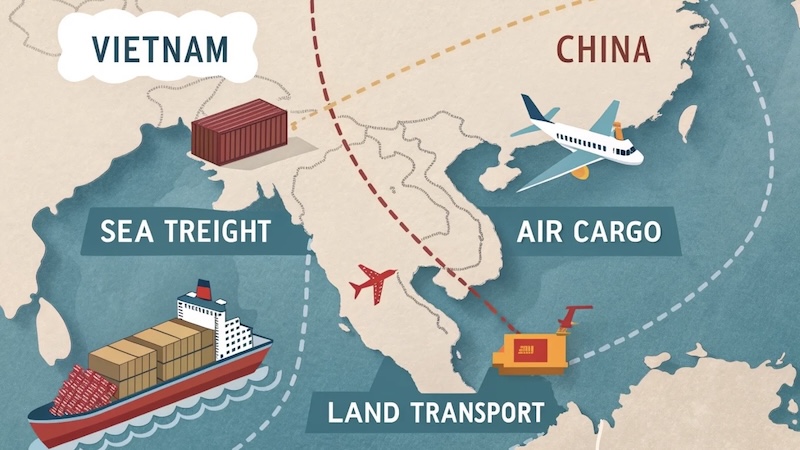
What Actually Separates the Two
China’s edge is not the lowest wage, it is density: materials, parts, tooling, and assembly sitting inside one region. A product needing five materials and three production steps gets made and coordinated in one place, without shipping half-finished goods across borders. That depth is most of what a buyer is paying for when they choose manufacturing in China, and it is what a younger supplier base cannot build quickly.
Vietnam competes on a different strength: lower labor cost on simple goods, plus distance from US-China tariff friction. For labor-driven categories it wins on unit price, and for tariff-sensitive lines it gives buyers a second country to place work in. What it does not match is the dense, all-in-one supplier network behind the China supply chain advantage, which is why complex products still lean toward China.
Working out which side of that split your own product sits on, before you commit to a country, is the first question an experienced sourcing team settles.
Where China Still Wins
When a product has many components or needs real customization, China’s depth pays for itself. Alternative materials, custom colors, and modified packaging are sourced locally, and a design change gets sampled fast because the parts are next door. That gap widens with every part you add.
Electronics is where it is widest. The Shenzhen electronics ecosystem puts nearly every component and module in one region, which makes prototyping and iteration quick. The same density concentrates risks like counterfeit parts, so verification still matters.
Private label is the other clear China win. A deep base of factories that will brand an existing product or build to your drawing gives you product development in China without building a supply chain from scratch. Vietnam is growing here, but the range of options is thinner.
Where Vietnam Pulls Ahead
For simple, labor-intensive goods, Vietnam beats China on unit price. Basic garments, footwear, simple furniture, and straightforward assembly are its sweet spot, where labor is the main cost and deep component sourcing matters less. If labor is the number that decides your product, Vietnam deserves a real look.
Tariff exposure is the other reason buyers move. For US-bound goods, some categories now carry extra duty from China, so shifting a tariff-sensitive line protects margin. That is why buyers working out how to protect your profit margin diversify the simplest products first.
The Catch: Vietnam Often Runs on Chinese Parts
Vietnam’s supply chain is real but young, and much of it still depends on Chinese components. Plenty of goods finished in Vietnam are assembled from materials shipped in from China, which adds lead time and adds cost the factory quote does not show. On a multi-part product, that dependency quietly erases the labor saving.
It also affects tariffs more than buyers expect. Origin rules look at where the real transformation happens, not at where the last box was sealed. Goods that are mostly Chinese parts with final assembly in Vietnam may not dodge duty the way a buyer hoped. Confirm the origin rules for your specific product before you assume a move solves a tariff problem.
Lead Time, MOQ, and Reorder Flexibility
Cash sits inside the lead time and the minimum, which is where the two countries diverge more than the price list does. Ask each supplier for its real minimum at your specification and the price break above it. A lower unit price sitting behind a higher minimum can tie up more cash than it saves.
Sample and production cycles differ for a structural reason. Where the components sit next door, a sample moves in days and a rerun starts quickly. Where parts arrive from China first, both clocks start later.
Reorder flexibility is the number most importers forget to ask about. Topping up a short shipment, replacing a rejected batch, or adding units mid-season is straightforward where the supply base is dense and slow where it is not.
Size your safety stock to the lane you actually pick, not to a published average. Ask what the supplier’s lead time did last peak season rather than what it quotes today, because the gap between those two numbers is the buffer you will have to fund.
Compare Total Cost, Not the Quote
The factory quote is one input, not the decision. Judge both countries on full landed cost, which means unit price plus tooling, freight, duty, inspection, packaging, and the management time each option really takes.
A cheaper Vietnamese quote on a component-heavy product can land higher than China once imported parts, longer lead times, and rework are counted. Fewer defects and tighter lead times beat a low quote from a thinner supply base more often than the spreadsheet suggests. Run the same full-cost model for each country instead of comparing sticker prices.
Compare the First Order, Not the Country Average
A country average tells you nothing about the two quotes on your desk. The comparison only works if both suppliers price the same thing, so send an identical specification, quantity, packaging, and delivery term to each and hold them to it.
| Decision factor | What to capture | What to verify |
|---|---|---|
| MOQ | Units and price breaks | Same spec both sides |
| Tooling | Cost and ownership | Who owns the mold |
| Sample lead time | Days to first sample | Existing or new tool |
| Production lead time | Days after approval | Peak-season allowance |
| Local component share | Parts made in country | The imported parts list |
| Freight and duty | Cost to your door | Origin rule applied |
| Inspection | Cost per visit | Same checklist both |
Separate the one-off numbers from the repeating ones. Tooling and samples are paid once, while MOQ, unit price, freight, duty, and inspection repeat on every order. A quote that wins on the one-off half can still lose across a year.
Ask the Vietnamese supplier what share of the product arrives from China. That single number explains most of the delivery and cost surprises that show up later, and a supplier who cannot answer it has told you something.
Then judge the two factories, not the two countries. A strong Vietnamese plant beats a weak Chinese one on the same product, and no national average will tell you which one you are holding.
How to Decide, and the China Plus One Play
The move for most importers is not either-or, it is matching each product to the right country. Keep component-heavy, customized, or quality-critical products where the supply chain is deepest, and move simple, tariff-sensitive, labor-driven lines to a second source. That is the China Plus One approach, and it captures Vietnam’s cost and tariff benefits without giving up the depth complex products need.
Whichever way you lean, verify at the source before you scale. A documented specification, a small first order, and a pre-shipment check protect you in either country, because a thin supplier base rewards caution as much as a deep one. Decide by product, not by headline.
FAQ
Q1: Is Vietnam’s quality as reliable as China’s now?
On simple products, capable Vietnamese factories match China well, but the pool of proven suppliers is smaller. On complex goods with tight tolerances, China’s deeper base makes a consistent supplier easier to find.
Q2: Which country is easier for a first-time importer?
China, because you are more likely to find a factory that has already built your exact product, which removes a whole category of first-order surprises. Neither country protects you from a weak specification, so write it properly before you send it anywhere.
Q3: Should I visit the factory before ordering?
That depends on the order value, the tooling you are committing, and how much verifiable history the supplier has, not on which country it sits in. Where the record is thin, a visit or an on-site audit earns its cost in either country.
Q4: Is communicating with Vietnamese factories harder?
Both run on English email with a local team, so the day-to-day is similar. China’s longer export history means more factories already read Western buyer expectations, while a newer Vietnamese supplier needs a more detailed specification.
Q5: Can I get factories audited and inspected in Vietnam as easily as in China?
Yes, and the practical differences are booking time and travel cost rather than availability. Brief the inspector with the same checklist and the same signed sample you use in China, since a report is only as good as the standard behind it.
Q6: Will my Chinese supplier lower its price if I bring a Vietnam quote?
A credible competing quote is real leverage, especially on a simple product where Vietnam genuinely competes. On complex goods the Chinese supplier may hold firm, because that depth is hard to replace.
Q7: If I switch to Vietnam, does my Chinese tooling transfer?
Only if you own it, so confirm tooling and mold ownership in the agreement long before you consider moving. Molds you own can be shipped and re-approved at the new plant; molds the factory owns mean building tooling again.
Q8: Do I need a separate sourcing partner for Vietnam?
Some partners cover both countries, which helps if you plan to split products across the two, while others specialize in one. Ask about on-the-ground presence and audit capacity in each country rather than accepting a claim to cover everywhere.
Conclusion
China wins on component depth, customization, and repeatability, Vietnam wins on simple labor-driven goods and tariff relief, and neither answer holds across a whole catalog. Place each product where its own math points, and the country question stops being a strategy debate.
Judging whether a Vietnamese plant can really hold your tolerances, and whether the parts behind it still come from China anyway, takes someone who works both supplier bases. We do, as an experienced sourcing team, so the country decision is made on your product rather than on a headline about tariffs.