
Wholesale Markets in China: Which Fits Your Product?
China does not have one wholesale market; it has ten specialist cities and industrial clusters, and the expensive mistake is flying to the wrong one. Yiwu carries finished gadgets and accessories but will not answer a components question, and Guangzhou will not match Shenzhen for technical depth. The city you pick decides most of what a trip is worth.
| Sourcing Hub | Main Products | Best For |
|---|---|---|
| Yiwu | Small goods, gifts | Variety, low minimums |
| Guangzhou | Apparel, bags, fabric | Fashion depth |
| Shenzhen | Electronics, components | Tech and prototypes |
| Chenghai | Toys | Toy importers |
| Foshan | Furniture, appliances | Container-scale buying |
| Wenzhou | Shoes, leather, hardware | Category specialists |
| Hangzhou | Women’s fashion, silk | Fast fashion cycles |
| Shanghai | Fashion, mixed consumer goods | Export-ready suppliers |
| Xiamen | Stone and stone products | Stone sourcing trips |
| Beijing | Gifts, crafts, cultural goods | Culture-led product lines |
Pick the row that matches your product, and everything downstream gets easier.
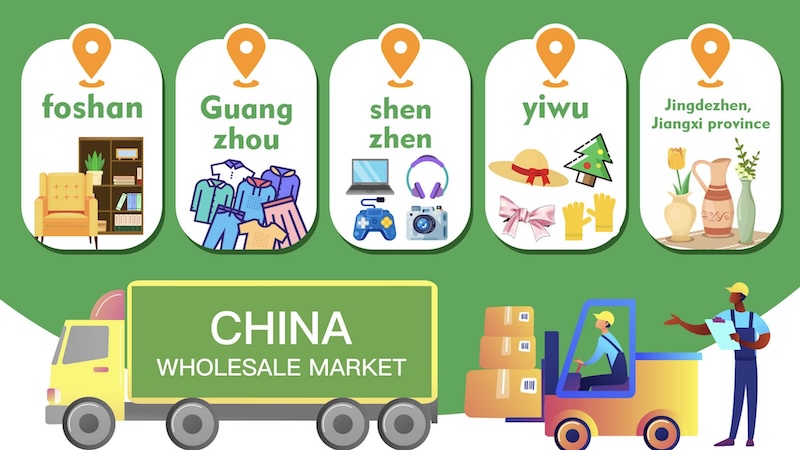
Start with the Product, Not the City
The first question is what you are buying, and it answers itself once the product list is written down. Small mixed consumer goods point to Yiwu, electronics to Shenzhen, apparel to Guangzhou or Hangzhou, toys to Chenghai, furniture to Foshan, shoes and leather to Wenzhou, stone to Xiamen.
The second question is what kind of supplier you need. Every market mixes factory outlets with traders, and a capable trader can run a custom order perfectly well. What matters is whether you can establish who controls the production, the tooling, and the quality before you commit.
Finding out which of the two you are standing in front of, before the deposit rather than after it, is the everyday work of supplier sourcing.
The third is quantity. Some markets sell by the piece, most sell by the carton, and a few effectively sell by the container. Turning up at a furniture showroom with a two-carton order wastes a morning, and so does asking a small-goods stall for a container price.
Yiwu: Small Goods, Low Minimums
Yiwu International Trade City covers a broader range of products than any other market in China, and it is the easiest place to start. More than seventy thousand booths across five districts cover gifts, household items, stationery, tools, party goods, and almost anything else light enough to ship cheaply.
Its advantage is comparison speed rather than the lowest price. Two dozen suppliers of one product sit a few minutes’ walk apart, and minimums are low enough to test a category. High-speed rail also puts Hangzhou and Shanghai within reach for factory visits. The district-by-district detail sits in the Yiwu market product list, which covers what each area actually carries.
Guangzhou: Fashion, Sold by District
Guangzhou is not one market but a set of specialized districts spread across the city. Clothing splits across several areas, Shisanhang, Baima, and Shahe among them, each serving a different style and price band. Leather goods, fabric, trims, and beauty products sit in separate clusters again.
The city rewards planning more than any other on this list. Districts sit far apart and keep different hours, so the map matters as much as the price list. The guide to Guangzhou wholesale markets lays that out district by district. For materials specifically, the Guangzhou fabric market is where garment projects usually begin.
Shenzhen: Electronics at Every Level
Shenzhen is where electronics get deep rather than merely available. Whole floors are given over to components, while others carry boxed consumer electronics, and many of the factories and assembly partners behind them sit in Shenzhen or in neighboring Dongguan and Huizhou.
It is also the market where verification matters most. Parts get relabeled, grades get mixed, and one model number can mean two different things at two stalls. The Shenzhen electronics markets reward buyers who test before they commit. The specific ways this catches buyers out sit in the Huaqiangbei market risks guide, which is worth reading before a first visit.
Chenghai: Toys
Chenghai in Shantou packs mold making, molding, printing, and assembly into one small district. That density can shorten sampling and production, depending on the tooling and testing a design needs, and it is why the district supplies so much of China’s toy output.
Toys carry one of the heaviest compliance loads of any category on this page. Testing, age grading, labeling, and whatever proof of conformity your destination asks for decide whether a toy can legally be sold there, not just whether the shipment gets released. In the Chenghai toy market, the paperwork question comes before the product question.
Foshan: Furniture and Appliances
Foshan sells through showrooms measured in kilometers rather than stalls. Furniture, lighting, kitchen fittings, and home appliances sit together within a short drive of the factories making them. Buyers filling containers come here instead of to a general market.
Showroom does not mean factory. Many of the spaces represent trading companies, and confirming who actually produces the goods is the first job on arrival, as the Foshan furniture market guide explains.
The Specialist Hubs
The last five entries in the table are worth a trip only when your product is their product. None of them is a general market: two are industrial clusters, one is built around a trade fair, one is a base for trading companies, and one serves a single narrow category. Each is excellent inside a narrow band and a waste of days outside it.
Wenzhou and Xiamen suit buyers who already know exactly what they want. Wenzhou is an industrial cluster rather than a market city, strongest in footwear, leather goods, and small hardware for buyers arriving with a fixed specification. Xiamen is a stone sourcing destination, built around its international stone fair more than around a year-round building-materials market.
Hangzhou is the one to pair with a Yiwu trip. Womenswear and silk move on short cycles there, and the two cities are close enough to cover in one week.
Shanghai and Beijing are the outliers. Shanghai works better as a base for export-oriented showrooms and trading companies than as a low-cost wholesale destination. Beijing is the narrowest of all ten, useful for gift, craft, and museum-style ranges and little else.
Markets, Platforms, or the Canton Fair
These are three different supplier pools, not three ways of reaching the same one. A market gives you stock, speed, and the ability to handle the goods. A platform gives you reach and a paper trail without the airfare.
| Channel | Strongest For |
|---|---|
| Wholesale market | Seeing and comparing goods |
| Online platform | Reordering, paper trail |
| Canton Fair | Comparing export-ready exhibitors |
Online works better for reordering than for discovery. Once you know the product and the supplier, the Chinese wholesale websites handle repeat business efficiently. A first order in a new category can justify seeing the goods, though the value of the order and the amount of customization decide that.
The Canton Fair is a third option with its own calendar. Held in Guangzhou each spring and autumn, it gathers export-focused exhibitors across a wide span of categories, split into phases by sector, which makes it efficient for comparing suppliers already used to overseas orders.
An exhibitor may be a factory, a trading company, or both, so the business type still needs checking, and whether the fair justifies your trip is weighed up in the guide to the Canton Fair.
What Happens After You Choose the City
Picking the market is the easy half. The rest of the trip is verifying the supplier, putting the terms in writing, staging the payments, inspecting before shipment, and confirming who acts as exporter of record on the customs paperwork.
Those steps are the same in every city on this page. They are set out in the guide to buying from wholesale markets, which covers verification, payment staging, consolidation, and the export arrangements that many small stalls handle through a third party.
Planning a Multi-City Trip
Group the cities by region rather than by product priority. Yiwu pairs naturally with Hangzhou and Shanghai in the east, while Guangzhou, Shenzhen, Foshan, and Chenghai all sit within a few hours of each other in the south.
Allow about two full days for a major hub. Markets keep their own hours and the good stalls take time to find, though a tightly targeted specialist stop can take less when the appointments are already booked. A trip covering four cities in five days usually produces photographs, not orders.
Timing decides how much of the market is even open. Most stalls close for the weeks around Chinese New Year, and the factories behind them slow down for longer. The Canton Fair periods fill Guangzhou’s hotels and clog its traffic whether you attend or not.
What a Market Trip Actually Costs
The flights and the hotel are the predictable part. What catches first-time buyers is everything after the stall price. Samples from several suppliers, courier charges to send them home, an interpreter for the days that matter, warehouse storage, and the inspection before shipping all add up.
Set that against the order value and the decisions a visit could change. For a standard product at modest value, paid samples, video calls, and a third-party inspection usually buy more certainty than a flight does.
The trip is worth the money when judgment is involved. Comparing materials, weighing several suppliers against each other, or committing to a customized or high-value order are the situations where being in the room changes what you buy.
Common Ways a Market Trip Goes Wrong
Arriving without a specification is the most expensive habit. Vendors quote against something concrete. A buyer holding a sample, a target price, and a quantity gets usable numbers; a buyer describing an idea gets a tour.
Buying on the first day is the second. The same product turns up at stall after stall, across a wider range of prices and quality levels than most buyers expect, so the offer that looked good on Monday morning usually looks average by Tuesday afternoon.
Treating a display unit as the product is the third. Showroom pieces are assembled carefully and stored well, while what ships is made at speed. That is why the checks after the order matter more than the one you did at the booth.

FAQ
Q1: What if my product line spans two markets?
Pick one anchor category and buy it properly, then add a second city only when its order value justifies the extra days. A consolidation warehouse can combine the shipments afterward.
Q2: Which markets work for very small orders?
Yiwu and the general small-goods markets, where a carton is a normal order. Furniture, appliances, and tooled products usually need a larger commitment, though paying the tooling separately can sometimes buy you a small first run.
Q3: Can I get factory prices at a wholesale market?
Sometimes, when the stall is the factory’s own outlet, though most stalls carry a margin for the service they provide. That margin often buys communication, checking, and consolidation you would otherwise handle yourself, so the question on repeat volume is whether those services are worth what they cost you.
Q4: Which market is easiest for a first-time buyer?
Yiwu, because minimums are low, the layout is logical, and the mistakes are cheap. Shenzhen and Chenghai both punish inexperience harder, since verification and compliance carry more weight there.
Q5: How much English can I expect?
Enough for prices, quantities, and dates in the export-facing markets, and much less once you leave them. Anything involving specifications, defects, or terms is where an interpreter or agent pays for itself.
Q6: Can I visit factories on the same trip?
Often, though only after confirming where the supplier actually produces and arranging the visit in advance. A booth may belong to a trader whose factory is in another city entirely.
Q7: How far ahead should I plan a visit?
Six to eight weeks is comfortable for flights and appointments, and longer if your dates fall near the Canton Fair. Visa timelines vary by nationality and consulate, so check yours first, since that is usually what decides how early you have to commit.
Q8: Can an agent do the buying while I stay home?
For known products, yes, and most repeat purchasing works that way, with someone walking the stalls, checking the goods, and consolidating them. An experienced agent can handle discovery too, provided you give them clear product, quality, and selection criteria.
Conclusion
China’s wholesale markets are not interchangeable, and the buyers who do well decide the city before they decide anything else. Match the product to the market, allow enough days for the districts you need, and treat the checks that follow as part of the same job.
Walking a district, telling a factory outlet from a trader, and checking who actually owns the tooling are all done standing in the aisle, not from a laptop. We cover that half through supplier sourcing, so the shortlist you built at home comes back with names you can order from.