Sourcing Agent vs Trading Company: Who Works for You?
A sourcing agent is hired by you and paid a stated fee, while a trading company sells you the goods and keeps its margin inside the price. Both can deliver the same carton to your warehouse, so the real question is who they work for.
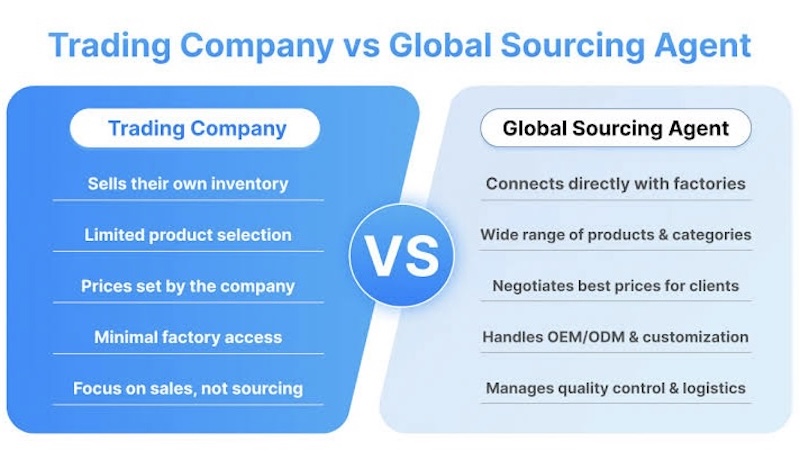
| Question | Sourcing Agent | Trading Company |
|---|---|---|
| Acts as | Your agent | Your seller |
| Earns from | Stated fee | Built-in margin |
| The factory | Usually named | Often withheld |
| If quality fails | Pushes the factory | Owns the claim |
| Best for | Custom, multi-factory | Simple repeat orders |
Both models can ship a good order, and the difference shows up on the day one does not.

Follow the Money
An agent is paid by you, so the factory price is a number it can show you, and a trader buys at that price to sell to you at another. That single difference sets everything below it. What matters is whether you can see how they earn, because some traders are open about their margin and some nominal agents also take supplier commissions.
Neither model is automatically cheaper, and one all-in number can easily cost more. A visible fee is not a penalty but information you can act on, and how those fees are structured sits in China sourcing agent fees rather than here.
You can usually spot a hidden markup by asking the same question two ways. Ask for the all-in price, then ask what the same order would cost if you paid the factory directly and paid a fee for the work.
A firm on a stated fee gives you two numbers that add up. One living on an invisible margin gives you a single number and a reason why the second cannot exist. The gap between those two answers is the part of your money you cannot audit.
Seeing the factory price and paying openly for the work is the model sourcing and quality control runs on.
Settle this before you negotiate anything else. It is one of the first calls when hiring a China sourcing agent, and every later term depends on it.
Can You See the Factory?
Factory access matters more than the quoted price, because it decides what you can verify. A transparent agent names the maker, supports direct contact, and helps arrange an audit. A trader more often keeps its supplier network private, since that network is the business.
That secrecy is rational for them and costly for you. Without the factory it gets much harder to compare Chinese suppliers on the same specification, to check capacity before a peak season, or to move production if the relationship ends. You are buying a result and renting the supply chain behind it.
Who Owns the Problem When Quality Fails
A trading company is your contractual seller, so your contract, your claim, and your after-sales problem sit with the trader rather than the factory. With an agent, the purchase contract can name the factory itself, or at least leave it visible to you, while the agent pushes corrective action on your behalf.
Picture a defective batch on your loading dock. Through an agent, someone you pay can be at the factory pressing your case, provided your scope covers it. Through a trader, you press the trader, who then decides how hard to lean on a supplier it wants to keep. That extra link is where a failed inspection in China can stall.
When a Trading Company Is the Better Choice
For standard products, small quantities, and fast repeat orders, one invoice and no supplier management is a real advantage. If you are reordering a catalogue item you already trust, paying a service fee to supervise a transaction that never varies is spending money to create work. That is the opposite of the case for a China buying agent, which pays off when the buying itself is the hard part.
The case flips when the order stops being routine. Custom development, several specialized suppliers, tightening quality control, or a supply chain you plan to own all favor an agent. If you are still weighing whether to use a middleman at all, that is the buying direct from factories question, and it comes before this one.
Five Questions That Show Which One You Are Dealing With
1. How is the money broken down? Ask for the goods, the service fee, and any third-party costs as separate figures in the quote. Merged invoices happen for accounting or export reasons, so judge the breakdown you are given rather than the number of documents.
2. Can I see the factory’s own quote? An agent can show you what the factory charged, because that number is not its income. A trader may choose to share it and does not have to, so read the answer as a signal rather than proof.
3. May I contact the maker directly? Many agents arrange it, though some route all supplier contact through themselves for control. The tell is whether they explain the policy or simply avoid the question.
4. Whose name is on the contract with the factory? Agents often buy in their own name on domestic platforms, so this alone proves nothing. Ask who legally owns the goods and who can bring a claim.
5. What do you earn if I place this order? The answer should be specific, whether it is a fee, a percentage, or a margin on the goods. Vagueness is the only wrong answer here.
Any company that calls itself an agent should answer all five without hesitating. One evasive answer, or a factory identity that does not check out, is enough on its own. How to check the rest of a firm sits in how you choose a sourcing company.
FAQ
Q1: Is a trading company the same as a wholesaler or a distributor?
Not quite, because a China trading company usually sells factory goods for export and often arranges production to your order. Wholesalers and distributors mostly resell finished stock they already hold. The label matters less than two questions: do they own the goods, and can you reach the factory behind them?
Q2: Can one company act as both, depending on the order?
Yes, and many do, quoting as a seller on stock items and working on a fee for custom projects. Ask which model applies to your specific order rather than to the company in general, and get the answer in writing.
Q3: Is going through a trading company always more expensive?
No, and on small standard orders it can be cheaper once you count your own time. The risk is not the price itself but that you cannot see what sits underneath it, so a good deal and a bad one look identical.
Q4: If I use a trading company, can I still ask which factory makes my product?
You can always ask, and a trader is under no obligation to answer, which is how most of these conversations end. If factory identity matters, get the disclosure agreed in writing before you place the order, not after a problem appears.
Q5: Which one handles mixed orders from several factories in one shipment?
Both models can. A trader may offer one sales invoice and take ownership of the consolidation, while an agent coordinates several factories and keeps supplier costs and identities visible to you.
Q6: If a trader arranges production to my design, who owns the tooling?
Ownership and location are separate questions, so a mold can be legally yours while sitting in a factory you have never been named to. Put ownership in writing, then ask where it is kept and who is allowed to move it.
Q7: Whose name appears on the export documents?
With a trader it is often theirs, though some ship through a third-party export company. With an agent it varies, because the factory, the agent, or an outside exporter may appear on the paperwork. Confirm whose name will be on the export declaration before the booking is made.
Q8: Can I start with a trading company and move to an agent as I grow?
Yes, and it is a common path, since a trader lowers the effort on early small orders while an agent adds value once volume, customization, or quality control rise. The catch is that you may have to rediscover the real factory later, because the trader had no reason to reveal it.
Conclusion
You are not choosing between an honest model and a dishonest one, but between seeing the supply chain and not seeing it. A trader sells you an outcome and keeps the machinery, while an agent sells you access and charges for it openly.
Renting a supplier relationship works until the day you want to change something the trader controls. We hand you the factory, the price, and the documents from the start, through sourcing and quality control, so what you build is yours to keep.