
Laser Cutting Services in China: When to Skip the Mold
For flat metal parts in runs of a few hundred, laser cutting can remove the tooling from the job completely. Stamping needs a hardened die cut for one shape, while a laser only follows your drawing file. The break point comes down to simple math: order size, design stability, and how much of the part is genuinely flat.
| Laser Cutting | Stamping | CNC Machining | |
|---|---|---|---|
| Tooling cost | None | High per shape | None |
| Best for | Hundreds to low thousands | High-volume repeats | Complex 3D parts |
| Design changes | Edit the file | Rebuild the die | Edit the file |
| First parts in | Days | Weeks | Days |
Whether the job needs a dedicated tool at all decides your first-part date and your unit price.
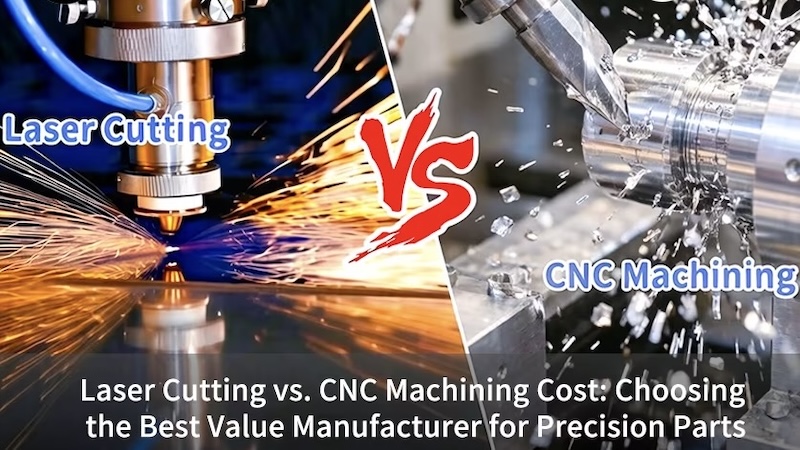
Laser Cutting vs. Stamping: Where the Cost Crosses Over
Tooling only pays when enough parts spread its cost, and most first orders never get there. For an order of 200 to 500 units, a stamping die often costs more than the parts it will produce in the first year, and it produces nothing you can sell. If you are still weighing cutting against stamping, machining, or casting, choosing a manufacturing process shows where each one wins.
Take 300 stainless brackets for a field test, and you already know one change is coming after the first install. Stamping wins on unit price, at $1.20 against $4.00 cut, but the die costs $3,000 while laser setup is $150. Divide the tooling gap by the saving per part, and stamping only starts paying back near 1,000 pieces.
| Order Size | Laser Total | Stamped Total | Cheaper |
|---|---|---|---|
| 300 | $1,350 | $3,360 | Laser |
| 1,000 | $4,150 | $4,200 | Laser |
| 5,000 | $20,150 | $9,000 | Stamping |
Making that call before any money moves is the first thing our prototype hardware sourcing work covers.
Design freedom is the other half of the case. With no die in the loop, a revision happens in the file and costs a fraction of reworking tooling. Teams doing rapid prototyping in China can cut three versions of a panel, mount all three, and keep the one that fits best.
Minimum orders get easier too. Factories still charge for programming, material, and machine setup, but with no tooling bill to recover, a small batch stops being a fight. Expect a setup charge or a slightly higher unit price instead of a hard floor of a thousand pieces.
What Laser Cutting Does Well, and Where It Stops
The process cuts flat sheet, and it cuts it very well. Steel, stainless steel, and aluminum run on fiber machines, while acrylic needs a different machine type altogether. A large shop in Guangdong will cut mild steel up to about 20 mm thick, with lower limits on stainless and aluminum.
Machine power alone proves nothing. Ask which materials and thicknesses the shop cuts every week, which cutting gas it uses, and for sample parts made in your own material. Then confirm tolerance, smallest hole size, and edge quality on your exact part.
The one thing it cannot do is form. A cut part leaves the machine flat, and bends, welds, threads, and coatings all happen downstream. An enclosure or cabinet is really a stack of flat parts bent and welded together, so buyers sourcing metal products from China should quote the whole chain, not the cut alone.
A complex outline costs cutting time, while depth costs an extra process. Vent patterns and odd shapes add minutes on the machine, but anything with height has to be bent, welded, or machined. One base enclosure in five sizes shares a single workflow. That split matters when you buy a hardware import from China in mixed lots, where a few deep parts pull the whole order into a slower process.
Sharp Edges: The Defect Buyers Miss
Laser cutting can leave sharp or rough edges on the underside of the cut, especially on thicker material or when machine settings drift. These rarely show in photos, so they slip past a remote check and reach your customer instead.
Good shops control the problem with stable cutting settings, smoothing every edge that hands will touch, and laying parts on the sheet so the rough side ends up where nobody sees it. Ask who inspects the edges and how quickly rework happens, rather than leaving the packing team to catch it at the last minute.
The drawing decides what actually gets inspected. A file sent with “cut as per drawing” lets the shop cut for speed and nothing else. Mark the critical dimensions, the faces customers will see, and the areas that must stay free of scratches. Since those files carry your design, read how to protect your product idea before they go out to five shops for quoting.
How to Compare Laser Cutting Quotes from China
Ask for three price tiers, not one price. Request the same part quoted at prototype quantity, pilot quantity, and a modest production run. The tiers show where the per-part price flattens, which is the number you put against a stamping quote and its die cost.
Make every quote answer the same four points: material grade and thickness, cutting, secondary work, and packing. A lump sum with no breakdown hides assumptions you cannot see. Send the same complete package every time, the way you would when you source custom products, and the numbers become comparable.
Pin the material grade in writing. Some shops quote a similar-looking local grade where your drawing says 304 stainless, which changes how well it resists rust, how it welds, and which rules your product has to meet. If the part turns out to need real depth rather than a flat outline, price it as CNC machining in China before you assume cutting is cheapest.
FAQ
Q1: Can Chinese shops cut copper and brass?
Fiber lasers handle reflective metals such as copper and brass, while older CO2 machines often cannot. Ask which machine type will run your job before you assume the material is available at the quoted price.
Q2: Is there a limit on how small a hole or slot can be?
As a starting rule, keep holes at least as wide as the material is thick, and treat narrow slots the same way. Smaller openings are often possible, so ask the shop to confirm yours with a sample before the drawing is final.
Q3: Why can’t inner corners be perfectly sharp?
The beam has width, so an inside corner ends up with a small radius instead of a knife edge. Allow for it on the part that fits against it, or ask for a relief cut in the corner where a sharp fit really matters.
Q4: Can the machine mark part numbers or a logo while it cuts?
Most shops can etch numbers, logos, or fold lines in the same setup for a small extra charge. It costs far less than a separate printing step, though the result is a surface mark rather than colored print.
Q5: Why does the price per piece change when I adjust the outline?
Your parts are laid out together on one standard sheet, so a small change in shape can waste or save material across the whole sheet. Ask how many parts fit per sheet, then adjust the outline if the saving is worth the design work.
Q6: What is a reasonable setup charge on a small order?
Judge it against the job, not the order value, since on a simple part it should sit near an hour of shop time. A charge that exceeds the value of the parts themselves signals the job is too small for that shop. Ask for it on its own line, because a shop that buries setup in the unit price makes small reorders look worse than they are.
Q7: Why do my stainless parts have a discolored edge?
Cutting with oxygen leaves a dark, burnt-looking edge, and that layer changes how well paint sticks and how the metal welds, not just the color. Nitrogen gives a clean edge at a higher price, so name the gas whenever the part will be coated, welded, or seen.
Q8: If I move to stamping later, can I reuse the same drawings?
The flat shape carries over, but a die needs its own check on where the metal folds, how close the holes sit to the edge, and which way the sheet was rolled. Budget for a fresh design check at the switch, not just the cost of the die.
Conclusion
Get your crossover number out of the first round of quotes. Send the drawing to a cutting shop and a stamping shop together, and ask the second to name the die cost separately. Those three figures give you one quantity to watch, and every reorder gets checked against it instead of guessed again.
Matching the machine to your material, controlling edges nobody can feel from another continent, and checking parts before they ship are hard to run at a distance. That is the work our team puts into laser cut metal parts, from the first quote to the packed carton.