1688 Purchasing Agent: Buy from China’s Domestic Market
A 1688 purchasing agent is how most overseas buyers actually reach China’s domestic wholesale prices, because they clear the barriers the platform was never built to handle for foreigners. 1688 is Alibaba’s domestic marketplace, so the prices can be lower, but everything about it is built for buyers already inside China.
| The barrier | What an agent does |
|---|---|
| Chinese listings | Searches and reads Chinese |
| Domestic payment | Pays sellers in RMB |
| Domestic shipping | Receives and consolidates goods |
| Export and freight | Handles documents and shipping |
| Checking goods | Only what you commission |
1688 offers domestic pricing, and an agent is what makes that pricing reachable from abroad.

Why 1688 Is Cheaper Than Alibaba
The price gap is mostly about who each platform is built for, not a secret discount. Alibaba.com listings often include export-facing sales, documentation, payment, and service costs. When the same supplier also sells on 1688, its domestic listing may be cheaper because it offers less export support.
1688 also tends to allow smaller minimums than Alibaba. Where an Alibaba supplier might want several hundred units, many 1688 sellers accept far smaller quantities, which makes it practical to test products before committing to volume. To push a minimum lower still, it helps to negotiate a lower minimum through an agent who already has the supplier relationship.
None of that lower pricing helps until you can actually transact. Among the Chinese wholesale websites, 1688 usually shows the lower domestic price and asks the most work of an overseas buyer, and our comparison of 1688 vs Alibaba weighs the two on total delivered cost rather than the sticker.
The Five Barriers to Buying Direct
1688 is built for domestic Chinese businesses, so foreign buyers hit five walls almost at once. Each one is manageable, but together they make unassisted buying impractical for most overseas retailers and ecommerce sellers.
Mandarin comes first, and machine translation clears only the surface of it. The listings, specifications, supplier chat, and reviews are written for local readers, and a mistranslated material can produce the wrong product entirely.
Reading a Chinese listing, paying a domestic account, and turning many parcels into one export shipment is exactly what purchase management covers, and none of it is optional on 1688.
Payment is the second, and often the hardest. Many 1688 sellers expect RMB through domestic systems like Alipay or a mainland bank account, which most overseas buyers cannot set up, so completing a transaction directly is difficult. Cross-border payment and shipping options exist in some markets, but they are not the default route and cover only the payment step.
The last three are shipping, export, and verification. Suppliers ship to domestic Chinese addresses and stop there, many smaller sellers do not handle export documentation, and you cannot vet production or catch a quiet change of material from the other side of the world.
What Your Agent Actually Does on 1688
An agent is your partner on the ground, and their job is to turn a domestic-only platform into a door you can walk through. They search 1688 in Mandarin, read what the listing actually commits the seller to, and flag the signs that a shop is reselling rather than making.
Working through the basics to verify the supplier, meaning the license, the trading history, and the product range, confirms identity and fit and surfaces the doubts worth chasing. Whether the equipment, the capacity, and the subcontracting behind it match your order still needs a sample, a factory visit, or an audit.
On payment, the agent acts as your financial bridge. You pay them in an agreed currency, and they convert to RMB and pay the sellers from their domestic accounts, so you rarely need a Chinese bank account or entity of your own.
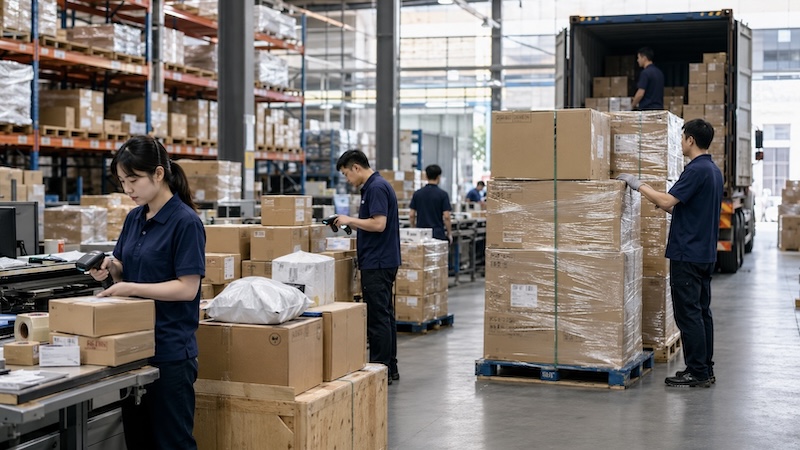
On the physical goods, the agent is your eyes before anything leaves China, but only within the scope you bought. Suppliers ship to the agent’s warehouse rather than to you, and what happens next is whatever the quote says.
Signing for a parcel, photographing it, counting units, and checking it against your specification are separate services, so get each one named in writing. Add a pre-shipment inspection when the order justifies functional or dimensional testing.
The warehouse then combines shipments from every supplier into one export-ready load, and the agent arranges export through its own license or a licensed exporter and freight partner. Choosing between air and sea, or the right container size, is where combining parcels can offset part of the fee, though whether it covers the whole fee depends on your volumes.
When 1688 Is Worth It, and When It Is Not
1688 shines for variety, low minimums, and testing, which makes it a scouting and small-batch tool more than a bulk-only channel. It is strong for fashion accessories, home decor, kitchenware, small consumer goods, and packaging, often from sellers who never bother listing on Alibaba. Taobao, its consumer-side sibling, works the same way from abroad, so buying from Taobao needs the same agent setup.
It is a weaker fit for bulky, certification-heavy, or highly custom products. Large appliances, anything needing formal compliance paperwork, or a fully bespoke design are usually better handled factory-direct.
Whether 1688 actually saves you money comes down to total landed cost, not the listing price. Add the product price, the agent fee, domestic shipping in China, the checks you commissioned, combining the parcels, and international freight before you compare it with an export-platform quote.
How to Choose a 1688 Agent
The right agent is defined by verification and transparency, not by the lowest fee. A cheap agent who only glances at your goods can cost you far more than a thorough one when a batch is wrong, so weigh the checking and the honesty over the headline rate.
Confirm how they charge before you commit. Agent charges usually run as a percentage of product cost or a flat fee per order, and comparing sourcing agent fees fairly means comparing the total against what the service includes.
Ask to see the supplier’s original 1688 quote, the exchange rate applied, domestic shipping, and any storage fee as separate lines. An agent who buries those in one number can quietly earn a hidden markup on top of the fee you agreed.
Then test the things that predict how they handle trouble. Ask what the warehouse check actually covers, and who owns and staffs the site that receives and consolidates your goods. Then watch how fast they reply during your first few messages, since a slow answer now is a slow answer when a shipment has a problem.
FAQ
Q1: Can an individual buyer use a 1688 agent without a company?
Yes, most agents work with individuals and small businesses, since they buy under their own Chinese entity. Import clearance at your end is the separate problem, and that is where a private buyer usually gets stuck.
Q2: Is my money protected when I buy through a 1688 agent?
Your protection depends on the agent agreement, supplier terms, payment records, and inspection before shipment. It is not the same transaction protection offered by Alibaba Trade Assurance, so the agent’s reputation and written contract matter more here.
Q3: Are 1688 listing photos reliable?
Often they are stock images reused across many sellers, so ask the agent for photos of the goods sitting in the warehouse before anything ships. That check also catches a seller who quietly substituted a similar model.
Q4: Will a good agent tell me which supplier the goods came from?
A transparent agent will share supplier details and let you build a direct relationship over time, while a less honest one hides the source to protect a markup. Ask about this before you commit, since it signals how the whole relationship will run.
Q5: What happens if the goods fail inspection at the agent’s warehouse?
A good agent documents the problem with photos and raises it with the seller before anything ships, then negotiates a replacement, rework, refund, or credit, though the result depends on the written terms and the seller’s cooperation. Catching it in China rather than after the container lands is the entire value of that warehouse check.
Q6: Is 1688 quality worse than Alibaba?
Not inherently, since some 1688 sellers are the same factories that supply Alibaba listings, so quality depends on the specific seller and your own checks. Ask the agent whether the seller has exported before, since a first-time exporter is more likely to miss packing and marking rules than to make a worse product.
Q7: How long does a 1688 order take through an agent?
Allow a few days for the goods to reach the warehouse, a few more for the check and consolidation, then the international leg, which runs days by express or several weeks by sea. Build in a buffer for customs and Chinese holidays rather than counting on the fastest quote.
Q8: When should I move from 1688 to a direct factory order?
Once a product proves itself and your volumes climb, dealing with the factory directly gives you more control over quality, customization, and cost. Treat the new supplier as fresh, re-vetting and sampling before you scale, since a bulk order carries different risks than a small domestic buy.
Conclusion
1688 is one of the cheapest ways to source small and mid-sized orders from China, once someone clears the barriers between you and those prices. Get the agent right, and a domestic-focused marketplace becomes a supply line you can actually run.
1688 prices are real, and so is the work of moving those goods out of the country. We carry the language, the payment, and the paperwork, which is what purchase management means on a domestic platform.