
China Inspection Cost: What You Pay and What You Save
Inspections in China are priced by the man-day, and in the main Guangdong cities one inspector for a normal working day starts around $300. That figure assumes one factory in a hub city, one product line, standard hours, and no special equipment. The real question is not the rate but what the day covers, and what a bad container would have cost you instead.
| What you pay for | What it usually covers |
|---|---|
| One man-day | One inspector, one day |
| Travel to plant | Included in main hubs |
| Report delivery | Same-day, with photos |
| Second visit | Billed again, payer set separately |
Two quotes can look identical and buy very different work.
How Much Does Product Inspection in China Cost?
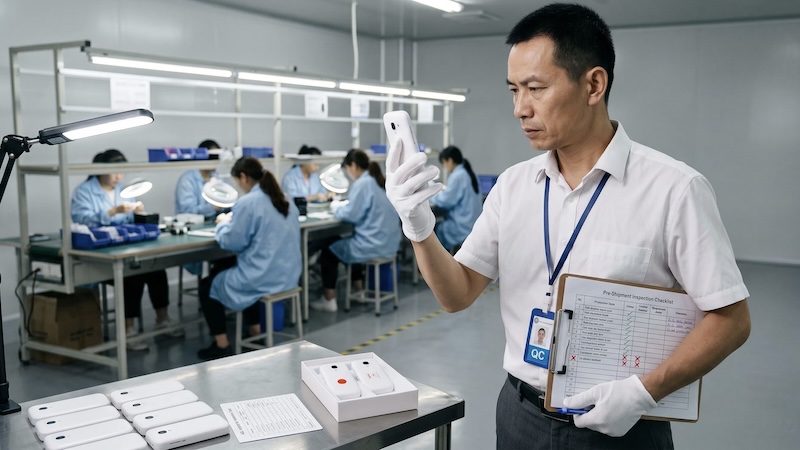
The man-day is not just looking at products. It covers getting to the factory, pulling the samples, checking sizes and functions, counting cartons, recording faults, and writing the report, which is why the same rate buys a different amount of work at different factories.
The rate question and the how-many question are the same question. Paying a low day rate five times over costs more than paying a fair one once, which makes it a quality control in China decision before it is a price comparison.
Working that out order by order, rather than buying a standing package, is what quality control does before anyone quotes you a day rate.
What Is Actually Included
“All-inclusive” means nothing until someone writes down what the inspector will actually check. Three questions separate a real quote from a headline number. Does the fee cover travel to that factory, or only to the city? Is the report included, and how detailed? Does a weekend, a rush booking, or a second product line cost more?
The surprises are rarely the day rate. They are the add-ons after you book: an overnight stay, overtime on a big shipment, extra time for a wide product range, or a special checklist can all land on the invoice later. A detailed quote upfront costs you nothing and prevents most of them.
What Pushes the Cost Up
Product complexity is one of the biggest cost drivers, because it changes both the time and the skill needed. A plain textile check and an electronics check are not the same job. Function tests, measurements, assembly checks, and barcode scans all take time, and time is what you are buying.
Order size and how much you want checked matter more than the order value. More cartons, more SKUs, and a larger sample all extend the day. Sample size comes from the batch size and the inspection level you choose, meaning how large a sample the standard pulls, while your agreed AQL standard sets the accept and reject limits for each defect class.
Ask what sample size the quote assumes, because that decides how much work the inspector can finish in a day, and it is the line most quotes leave out.
What a Typical Inspection Quote Looks Like
A typical quote for a Shenzhen factory might show a single man-day, local travel included, a same-day photo report, and a separate charge if the batch needs to be checked again.
Move the factory and the quote moves with it. A plant a few hours outside the city can add transport, a hotel, or a second man-day. An order with many SKUs may need two days or two inspectors, because each variation needs its own samples and checks.
The mistake is comparing two numbers that describe different jobs. A $220 quote for one short visit is not cheaper than a $300 quote that covers the full sample, the function tests, the travel, and the report. Some of the gap is scope, and some is experience, internal review, report quality, and the liability the provider will carry.
Ask every provider to state the location, sample size, working hours, testing scope, and extra charges in one proposal, then compare those rather than the rate.
What Inspection Adds per Unit
A $300 inspection on a $20,000 order of 5,000 units adds six cents a unit. Even a second visit after rework only takes it to twelve cents. Compare that with replacing faulty stock, paying return freight, losing marketplace ranking, or missing a retail delivery window, and the inspection cost is usually easy to justify.
The math flips on a $1,000 trial order. There, $300 adds nearly a third to the cost of the goods, and a standing rule to check everything quietly becomes a tax on your smallest orders.
Which Orders Deserve the Check
Inspect when the downside is real: a first order with a new factory, a supplier with a bad run behind them, goods with safety or compliance exposure, a launch you cannot miss, or a marketplace that punishes returns. In those cases the check is cheap insurance.
You can reasonably skip it when the stakes are small. A repeat order of a simple product from a factory with a long clean record, or a sample-sized shipment where a fault costs you an afternoon, does not always need an inspector on site.
The same money buys very different value across those two cases, which is why a standing inspection package usually overspends on one and underspends on the other.
A fail is not wasted money but the money doing its job. A check that catches a problem before the balance payment is the whole point, and what you do with a failed inspection in China decides whether that man-day saved the order or merely recorded it.
How to Spend Less Without Checking Less
Check where the fix is still cheap, which is rarely at the end. An initial production check catches a bad material batch before it is built into anything, and a during production inspection catches a drift mid-run while most of the order is still ahead of you.
The last cheap moment is the loading bay, not the warehouse. A container loading inspection settles the count and the stacking while the doors are open, and all three carry roughly the same rate per day, so the money question is which visit you need rather than which is cheapest.
Coordinate nearby inspections. Two factories in the same city on consecutive days can cut the travel cost, even though each one still needs its own booking and its own report.
Send a real brief. An inspector with clear defect definitions and an approved sample works faster and argues less, which is also how you avoid paying for a second visit to settle something that should have been written down. If you are still choosing a provider, how you pick an inspection company matters more to the final bill than the day rate does.
FAQ
Q1: Can the factory’s own QC report replace an inspection?
Only when the risk is low. A factory report can be useful information, but it is not an independent decision and carries little weight if the shipment turns into a dispute.
Q2: How many man-days does my order need?
It depends on the number of cartons, SKUs, samples, and function tests, not on the order value. Ask the provider to state both the man-days and the planned sample size in the quote.
Q3: Do I get a better rate if I book several inspections a month?
Often yes, since a steady flow saves the provider scheduling and travel time. Ask for the volume rate in writing with the scope attached, or the discount quietly arrives as a shorter visit.
Q4: Are product testing fees included in the price?
Basic function checks usually are. Laboratory testing, destructive tests, and checks that need special equipment are normally priced separately, so list every requirement before you ask for the quote.
Q5: Do I pay if the factory is not ready when the inspector arrives?
Usually yes, since the inspector’s day is already reserved. Before a final check, confirm production is finished, the goods are packed, and the full quantity is there; before an early or mid-run visit, confirm only that enough units are built to sample.
Q6: Who pays for units damaged during testing?
The units come out of your finished order, and the inspection fee normally does not cover their value. Agree in advance how opened, damaged, or destroyed units are recorded and whether the factory replaces them.
Q7: Who pays when the lot has to be checked a second time?
Your purchase order should settle that before production starts. Many buyers put it on the factory when the fail comes from production defects or incomplete rework.
Q8: Can I claim the fee back if defects are missed?
Not automatically. Compensation depends on the liability terms in the service agreement, and a sampled inspection cannot promise every unit, so read those terms before booking.
Conclusion
Inspection is not an expense you weigh against the factory price. It is the cheapest way to find out whether the factory price bought you anything sellable. Judge the quote by the man-days, the sample size, and what happens after a fail, not by the headline rate.
Put the money on the orders that could take a season away from you, leave it off the ones that could not, and keep the standard consistent so every visit produces a decision you can act on. We size the checks to the order and report against your own written standard, through quality control, so a day at the factory comes back as an answer rather than a photo album.