How to Write a Quote Request That Gets Real Prices
A quote request pulls real, comparable prices out of suppliers because it spells out exactly what you need, so every factory prices the same thing. A one-line price question only gets you a number you cannot trust.
| Weak inquiry | Strong quote request |
|---|---|
| “How much for these?” | Exact specs, quantities, terms |
| One vague quantity | Pricing at several volume tiers |
| No company details | A real business introduction |
| Quotes you can’t compare | Quotes on identical requirements |
A weak inquiry returns guesses and a strong one returns comparable quotes.
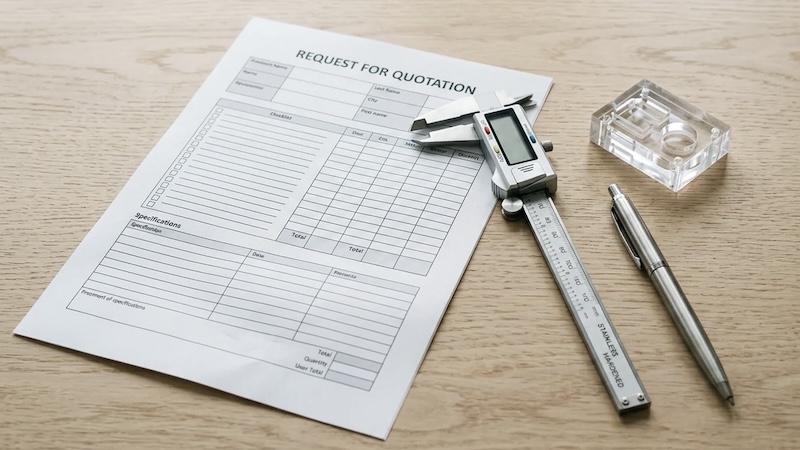
Why a Quote Request Beats a Simple Inquiry
A price inquiry asks one thing, how much, while a quote request asks everything that decides the number before production starts. That gap separates replies you can rank from replies you can only guess at, and it pays off only when the same document reaches every name on the list you built to find Chinese suppliers.
Without a structured request, one supplier quotes premium materials while another quotes a cheap substitute, and one includes tooling while another leaves it out. The numbers cannot be compared. A detailed request also marks you as a serious buyer, which matters when a sales team reads many vague messages a day. Whether direct or indirect sourcing fits you also shapes how you target suppliers.
Writing that request once, then sending it to a shortlist that has already been checked, is where supplier sourcing starts before a single price comes back.
What Every Quote Request Must Include
Five sections turn a vague message into a request factories can quote accurately. Miss one and the quotes come back incomplete or impossible to compare, so build your request around all five:
1. Company introduction. Two or three sentences on who you are, what you sell, and which market you serve.
2. Product specifications. The most important part: material grade and finish, dimensions, exact color codes, performance requirements, needed certifications, and drawings for custom items. Vague specs here cause wrong quotes and quality problems later.
3. Quantity and pricing. Ask for prices at several volume tiers, plus tooling cost as a separate one-time line, sample cost, and your currency.
4. Packaging and labeling. Specify retail packaging, master carton details, barcode placement, and any platform labels.
5. Shipping, payment, and terms. Quote on a specific shipping term with port and lead time, state your payment structure such as a deposit with the balance after inspection, and note that an independent quality check comes before final payment.
A Sample Quote Request
Here’s what a complete request looks like for a real product, where every line removes a guess the factory would otherwise make:
Product: Insulated water bottle, 500ml.
Material: 304 stainless steel body, food-safe lid with silicone gasket.
Insulation: Double-wall vacuum, 24 hours cold and 12 hours hot minimum.
Finish: Powder-coated matte, exact color code supplied, logo laser engraved.
Compliance: Must meet US and EU food-contact safety standards.
Inspection: Independent check required before balance payment.
Quantities: At 500 / 1,000 / 2,500 units, tooling separate.
Samples: 2 units with logo.
Custom electronics and branded goods raise the level of detail. OEM factories in China expect drawings, tolerances, and test standards attached to the request, so gather those before you send it.
How to Evaluate the Responses
When quotes arrive, resist judging on unit price alone. Put everything in one comparison sheet first, because only side by side can you see the real winner.
Give each supplier a row and each variable a column: price at each tier, tooling, sample cost, minimum order, lead time, payment terms, and certifications. If two quotes are far apart, do not assume one is simply cheaper, since the gap usually reflects different materials or assumptions rather than efficiency.
The lowest number rarely wins, because a supplier who answers every question and provides certificates is a safer partner than one with a rock-bottom price and gaps. Pay attention to what a supplier did not answer, since missing information is itself a signal.
If one supplier’s question reveals an ambiguity in your request, share the clarification with everyone at once to keep quotes comparable. And when you narrow to a few finalists, request free samples from China before any bulk order, since the sample stage tests whether they can actually follow your spec.
Before You Commit
A few steps protect you between choosing a supplier and placing the order. Skip them and a good quote can still turn into a bad order.
First, if your quantity sits below a supplier’s usual minimum, say so openly and explain you want a long-term partner, since negotiating a lower minimum is normal and easier when you are transparent.
Second, before you send drawings or proprietary designs to any factory, protect your product idea with the right agreement.
Finally, if you source across several factories, consolidating shipments in China can cut freight per unit, so factor that into your cost comparison before deciding.

FAQ
Q1: How many suppliers should I send a quote request to?
Three to seven is practical. Too few limits your comparison, too many creates follow-up work with little added insight. Focus on suppliers who specialize in your product, not the widest possible pool.
Q2: Is email or a messaging app better for sending a quote request?
Send the detailed request by email so there’s a clear written record and attachments stay organized. A quick message on WeChat or WhatsApp to flag that it’s coming often speeds up the reply, since many sales staff work mainly from their phones.
Q3: Do standard products really need full specifications?
Yes. A water bottle looks identical whether it’s made from cheaper or better steel, and the difference only shows in testing and durability. Specify the grade, or you may not get it.
Q4: Should I send drawings and full specs to a supplier I don’t know yet?
Share enough for an accurate quote, but hold back truly proprietary details until you’ve vetted them and put a basic agreement in place. For custom designs, a simple confidentiality agreement before sending files is worth the small effort.
Q5: Should I reveal my target price?
It cuts both ways. A target filters out suppliers outside your budget but can cap negotiation early. A middle path is to share a general budget range and ask for their best price at your volume.
Q6: How long should I wait for responses?
Most active suppliers reply within one to three business days if the request is clear. After about five days, a polite follow-up is fair. Silence or a generic catalog reply tells you how they’d handle your order.
Q7: A supplier keeps changing the price after quoting. What should I do?
Ask them to put the full price and what it includes in writing, tied to your exact specs and quantity. A quote that keeps moving usually means missing details or a bait-low opening number, so lock the terms before you commit a deposit.
Q8: What if every quote comes in above budget?
Revisit specs first, since some requirements add cost without much value, then revisit quantity, since a higher volume usually lowers unit price. If everything still runs high, a sourcing partner with factory relationships may find alternatives.
Conclusion
A quote request is the first test of your supplier relationship. The replies you get back mirror the care you put into the document you send. Detailed, professional requests get taken seriously, while vague ones attract price guesses and substituted materials.
Writing one request is work. Writing twelve, chasing the replies, and lining up numbers that actually compare is a job, and none of it happens somewhere you can walk in and ask. That is the stretch our supplier sourcing work covers, from the shortlist to the quotes that finally line up.