
Import Duty from China to the UK: What You Actually Pay
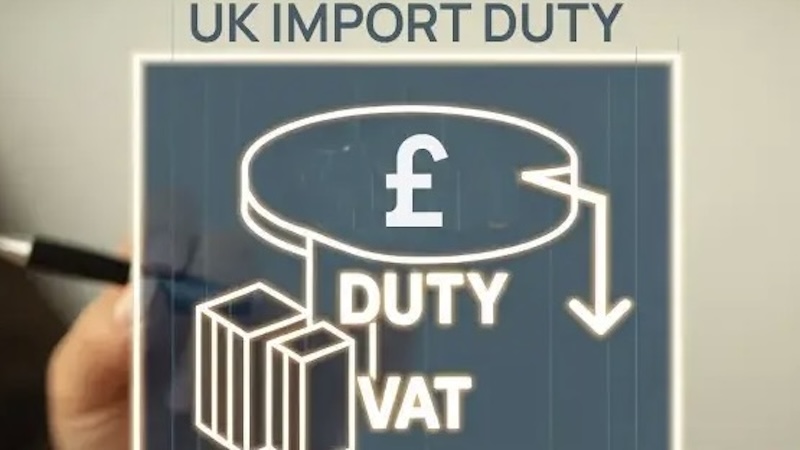
Duty is the small bill, but VAT is the big one, and only one of them ever comes back to you. Duty is charged on the goods plus the freight to the UK border, and VAT at 20% is charged on all of that, plus the duty and the inland costs on to your first UK address. On most consumer products the VAT bill runs several times the duty bill.
| The Charge | Who Pays It | Do You Get It Back |
|---|---|---|
| Customs duty | The importer | Only if you overpaid |
| Import VAT, usually 20% | The importer | Yes, if VAT registered |
| Clearance and handling fees | The importer | Never |
| VAT collected at checkout | The seller collects it | Only with a VAT invoice |
Which of those lines you can recover depends on your own registration and paperwork, not on anything the supplier quotes.
Where the UK Bill Comes From
Customs never starts from the number on your supplier’s invoice. A £10,000 order with £2,000 of freight to the border is charged duty nearer £12,000, and every fee your forwarder folds into one line gets taxed alongside it. Ask for UK shipping costs to be split at the border, because inland delivery belongs in the VAT figure rather than the duty one.
That makes speed a tax decision as well as a schedule one. The extra £3,000 you pay to fly the goods in is taxed like part of the goods, so two weeks saved costs more than the air freight quote shows.
Settling the duty rate and the invoice wording before the booking is made is ordinary order management work, and far cheaper than correcting it at the border.
Duty itself is usually the smaller number, and the rate comes from the commodity code your goods are declared under. Most consumer goods sit between zero and roughly 12%, but the wrong code can put you well outside that range, which is also where customs clearance from China starts going slowly.
Which Money Comes Back, and Which Does Not
Duty stays in your costs, but VAT usually does not. If your business is VAT registered and the import is declared under your own EORI, the import VAT comes back through your VAT return, normally within a quarter. So duty belongs in your selling price, while VAT belongs in your cash flow forecast.
Most first-time importers price this backwards. They treat the 20% as a real cost, decide the margin will not work, and walk away from a product that was profitable at the price they were quoted.
Ask your agent about postponed VAT accounting while the goods are still in production. It puts the import VAT on your VAT return instead of taking the cash out of your bank at the border. On a £12,000 shipment that keeps roughly £2,400 in your account for a quarter. Your agent will not raise it for you.
Why “VAT Included” Still Leaves You a Bill
A seller who collects VAT at checkout has collected one tax and nothing else. Duty and the handling fee are separate, and the £135 limit applies to the whole parcel rather than each item inside it. Above that line the normal import rules apply, so VAT is due at the border whatever the checkout page said, and duty follows if your code carries a rate.
The courier asking for money at your door is usually not a double charge. It pays the VAT and any duty for you, adds a fee for doing so, and passes the total on. If the seller also charged VAT at checkout, ask for the breakdown before you pay twice for the same tax.
The £135 relief also has an end date. The government has confirmed it will scrap the relief and bring in new arrangements from March 2029 at the latest, so parcels that arrive duty free today will start carrying tariffs. If you post parcels one at a time to UK customers, rebuild those numbers now, and check the EU import duty rules separately if you also sell into Europe.
Who Is the Importer on Your Entry
The importer of record is the business that legally brings the goods in, and it should normally be yours. That name goes on the customs entry, the declaration your broker files at the border, and it decides who owes the duty and who can reclaim the VAT. Under DDP shipping from China, the supplier usually arranges for a company other than yours to be named in that box.
Where somebody else is named on the entry, you never paid that VAT and there is nothing to reclaim. A delivered price can still be the cheaper deal, but compare it against your own cost with the VAT taken out, or you are comparing two different things.
The trade term you agree, whether FOB, CIF or DDP, says who is expected to handle the import, but only the entry and the contract say who legally did. Your reclaim rests on the monthly import VAT certificate HMRC issues, the C79, or the postponed VAT statement, while your shipping documents are what you need if the entry is ever questioned.
Nail the Paperwork Before You Order
The code has to be confirmed against the finished product, not against the factory’s paperwork. Check it on the real material, the real function, and everything in the retail box. Copying the factory’s HS code hands your duty bill to a party that will never have to pay it.
Your invoice has to describe what actually shipped. Customs reads the description, the value, the trade term and the code together, and a vague line or a suspiciously round figure is what brings a letter from HMRC a year later.
Before the deposit goes out, pin down the commodity code, what the carriage to the border really costs, whether you can recover the VAT, and whose company goes on the entry. Four answers turn a quote into a real price. Three answers and a guess is still a guess, however carefully you calculate your landed cost.
FAQ
Q1: Does my product need a UKCA mark, and does that change the duty?
The marking and the duty are separate problems. Great Britain still recognises the CE mark alongside or in place of UKCA for many product groups, so check which rule covers your category instead of assuming one mark replaced the other.
Q2: Do I need an EORI number before the goods leave China?
Yes. It is your customs identity in the UK, free from HMRC, and it has to exist at the moment your entry is filed rather than when the goods arrive.
Q3: Will HMRC accept an invoice written in Chinese?
An English commercial invoice is what you want on file, because an officer should not have to translate your paperwork before checking it. Ask the factory for a bilingual version at the pro forma stage, when changing it still costs nothing.
Q4: The mould was invoiced separately from the goods. Does customs still count it?
Often yes. Tooling you paid for and supplied to the factory can be added to the customs value even when it never appears on the goods invoice, so tell your broker about it rather than letting it surface later.
Q5: My supplier offered to declare a lower value. Should I agree?
No. You are the party signing for that figure, and the saving is small next to a penalty, a held shipment, or a compliance record that follows your company for years.
Q6: My order is arriving in two containers on different days. Is that one import or two?
Two entries and two sets of charges, because each arrival is declared on its own. The one to watch is the second entry picking up a different code from the first, so have both filed from the same instructions and compare them when they come back.
Q7: Can I get back duty I think I overpaid?
You have roughly three years from the payment to ask HMRC for a repayment, and the usual causes are a wrong code or freight counted twice. Most importers never look, so the money stays where it is.
Q8: HMRC has written to me about an entry from last year. What should I do first?
Pull that shipment’s entry, commercial invoice and freight invoice before you reply, because most questions are answered by paperwork you already hold. Reply inside the deadline even if the answer is incomplete, because if you say nothing HMRC will set the figure itself.
Conclusion
By the time the container reaches the border, the size of your bill is already fixed. Customs applies its rates to numbers other people wrote down weeks earlier, which is why the argument worth having is with your factory and your broker rather than with HMRC.
Getting the factory to describe the finished product honestly, and getting the broker to file in your company’s name, are the two jobs nobody can do from four thousand miles away by email. Our order management team sits between the two on the ground, so the VAT lands on your return instead of somebody else’s.