Bag Manufacturers in China: Can They Make Your Design?
Plenty of bag factories will take your order, and only some can make what you actually drew. Most buyers only discover the gap when the first sample looks nothing like the drawing they sent.
| A Capable Factory | A Weak One |
|---|---|
| Asks about material and stitching | Offers to add your logo |
| Has pattern and sample makers | Only has a production floor |
| Shows similar custom work | Shows generic stock photos |
| Quotes after questions | Quotes with no questions |
The left-hand column is what you are testing for, and you test for it before you commit.
A Bag Is Not One Product
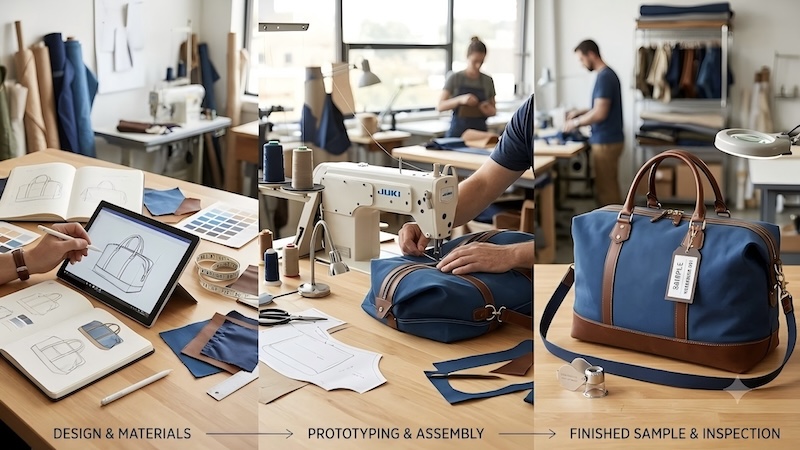
Outer material, lining, reinforcement, hardware, zippers, webbing, stitching, finishing: a bag pulls in eight supply chains before anyone sews anything. The factory worth having coordinates all of that rather than cutting and sewing whatever arrives.
Most workshops can copy a shape, and far fewer can develop one from scratch. Pattern making, sample development, and material sourcing are what separate the two, and none of it appears in a price list.
Every added feature costs more than it looks like it should. A hidden pocket, a curved panel, or a magnetic closure can each add pattern pieces, reinforcement, or an extra operation. Several changes together will often fit into one sampling round. Across consumer goods sourcing, few categories turn a loose specification into money this fast.
Telling a copy shop from a development shop before you send a design is the first job in supplier sourcing, and it is almost impossible to do from a listing.
Where the Factories Are
Bag manufacturing is clustered by product type, so matching your design to the right region saves months. Guangzhou and the wider Pearl River Delta form the strongest base for fashion handbags and accessories, with hardware and materials alongside.
Backpacks and functional bags sit elsewhere. In Fujian, backpack, school bag, and outdoor production is concentrated around Quanzhou and Hui’an, where factories already serve export buyers. Baigou in Hebei carries a full luggage and bag supply chain of its own.
A market is not a factory, and the two get confused constantly. A stall shows what exists and what it costs. The workshop that can build your version is usually a drive away.
Match the Design to the Factory’s Real Equipment
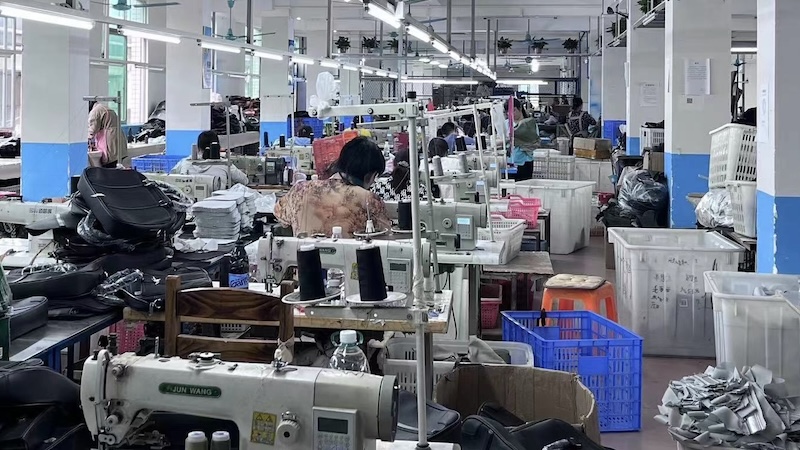
A workshop full of sewing machines can build some bags and not others. Edge painting, thick-material sewing, quilting, and welded waterproof seams are separate capabilities. A plant that accepted your design then quietly simplified a detail has told you to go looking. It may be capability, it may be cost, it may be a drawing nobody read properly.
Ask what happens inside the building and what gets sent out, then look at the line. Subcontracting is not disqualifying, but every step that leaves the building adds a coordination risk. Work in progress on a site visit or a live video walk shows what the plant does on an ordinary day.
Test the Factory Before the Price
A factory that quotes without asking questions has already made assumptions about your product. Material grade, lining, hardware finish, and stitch density all move the price. Silence on those points means the number is not for your bag.
Ask what they have built that resembles your design, then ask to hold it. A photograph settles nothing either way. A physical sample of comparable custom work shows pattern skill, edge finishing, and hardware fitting in one look.
Separate identity from capability, because they are two different checks. Verifying the company shows whether you are dealing with the plant or an agent. Checking factory capacity shows whether that plant can absorb your order without subcontracting it.
Send a Tech Pack, Not a Photograph
Ordering from a description rather than a specification is the most avoidable way a bag arrives wrong. That specification is the tech pack, and whatever you leave out gets decided by the factory in the direction of cost. A complete pack does not make you safe. Substituted material, production errors, and a gap between sample and bulk all arrive by other routes.
Five things belong in that pack. Drawings from every angle with exact dimensions, a full material list, precise color codes, construction detail, and branding placement with packaging direction.
When a first sample arrives with no questions asked, treat it as a warning. It means the gaps were filled by somebody who has never seen the product you have in mind.
Approve the Construction, Not Just the Look
A bag can look right and still be built to fall apart. Shape and finish are what buyers inspect. What decides whether it survives a year sits inside, in how the strap attaches and what sits behind it.
Put the hidden work in the specification and give it a test anyone can repeat. A stated load, a hold time, and a pass mark give the factory and the inspector one answer. Pulling until something gives proves nothing. On complicated designs ask for a cutaway sample too, since approving that alongside the finished piece stops production copying only the outside.
Samples, Minimums, and Timing
Custom bags take several sample rounds, and that is the process working rather than failing. What comes back first is the factory’s reading of your pack. The gap between that and your intent is what you paid to find out.
Sign off a physical reference and keep your own copy of it. Sample management is what gives you something to hold a factory to when the run drifts.
Minimums here are set by more than piece count. Fabric and leather arrive in rolls and hides, so a color you barely use can carry a bigger minimum than the bag. Custom hardware, zippers, logo method, and packaging each bring their own floor. Negotiating a lower MOQ works best once you have cut colorways rather than quantity.
Know What Actually Moves the Quote
Material is the number buyers watch, and it is not the only one that moves. Real leather can dominate a quote, and so can panel count, curved seams, and waste from an awkward pattern.
A lower quote can come from real advantages or from a lighter build, and you cannot tell which without asking. Better material buying and spare capacity lower a price honestly. So does thinner reinforcement, lighter lining, or a generic zipper.
Ask every supplier to state its assumptions, then price the alternatives. Get the lining weight, zipper brand, and hardware finish in writing, then ask what the next specification up would cost. Two prices without those assumptions tell you nothing at all.
Protect the Design and Check the Batch
A design is most exposed in the weeks you are shopping it around, so release it in two stages. Screening needs only enough to judge capability. The full pack goes to shortlisted factories under an agreement, before real quoting and sampling start. Skip the second stage and you are back to a quote built on guesses, which costs as much as protecting your product idea saves.
Bulk drifts from an approved sample quietly rather than obviously. Nothing looks wrong until the units sit side by side, which is why the retained reference has to come out.
Check the run rather than the sample. A pre-shipment inspection that opens cartons across the batch shows how far the build has slipped once nobody is picking the bag for you.
FAQ
Q1: How different are leather and PU factories?
Leather is cut from hides with flaws to work around, while PU arrives on a roll, so cutting and edge work differ. Larger factories often handle both, so judge by daily output and comparable work rather than by the claim.
Q2: Should I specify a zipper brand or let the factory choose?
Specify it, since the zipper is one of the high-risk parts alongside strap joins, handles, and stitching. Write the exact model into the order and check it again at inspection, because a specification alone does not hold.
Q3: Can I reuse the same pattern in a different material?
Rarely without adjustment, since materials differ in thickness and stretch. Expect a pattern change and a fresh sample round whenever the material changes, even when the shape stays identical.
Q4: Who pays for samples and development work?
You usually do, though a waiver can simply mean an existing sample, low development cost, or a standing sales policy. What matters is what the fee covers, whether it is credited against a first production run, and what a revised sample costs.
Q5: What testing do bags need before I sell them?
There is no single package, since it depends on the market, the material, and how the bag is used. Restricted substances in leather and some textile dyes are regulated in the EU, so confirm what applies to your material before production.
Q6: What happens to material left over from my order?
Agree it in writing rather than leaving it open. Surplus material, rejects, branded hardware, and packaging each need a stated outcome: returned, held for a reorder, reused, or destroyed.
Q7: Do factories keep my pattern after production?
Usually, and that is worth settling in writing before development starts. The pattern is what a competitor would need, and who owns it decides whether you can move factories later.
Q8: What tells me it is time to drop a factory?
One mistake is normal and a pattern is not. Unapproved changes that keep recurring, problems you hear about late, and promises that stop holding are the signals. Needing ever more supervision to get an acceptable result is the clearest one.
Conclusion
Bag factories are judged on whether they can build something new, and that never shows up in a quote. What you are buying is the skill to turn a sketch into a working pattern. Test that before price becomes the conversation.
Walking a line to see whether the machines match the drawing, holding a comparable sample, pressing on who owns the pattern: none of it travels well over email. Our supplier sourcing team does those three in person, before you commit to a factory.