EU Import Duty from China: One Tariff, 27 VAT Rates
The duty on your product is the same in all 27 countries, but the VAT is not. Where you clear moves your cash flow and your paperwork, not the duty.
| The Bill | Same Across the EU | Do You Get It Back |
|---|---|---|
| Customs duty | Yes, one tariff | Never |
| Import VAT | No, standard rates 17-27% | Usually: registered, in your name |
| €3 low-value parcel duty | Yes, since July 2026 | No |
| Clearance and handling | No, by country and agent | No |
What you finally pay is decided by the product, the freight, and which business is named as importer.
What Will You Actually Pay?
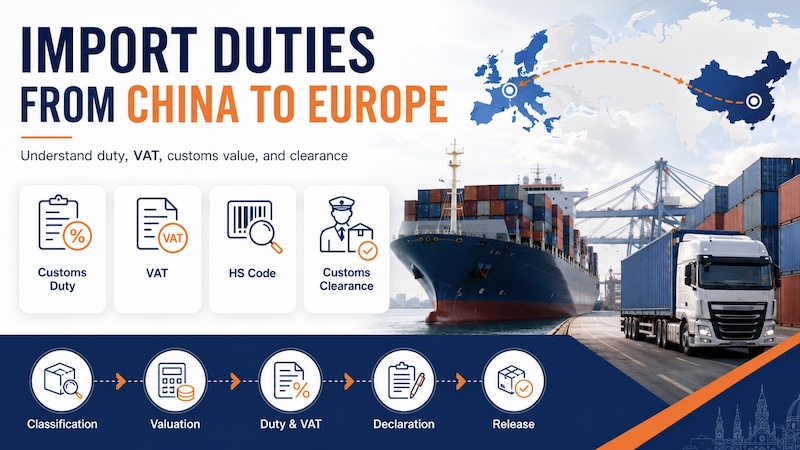
A €10,000 order does not just cost €10,000 when it lands in Rotterdam. Add the freight, the duty, the VAT, and the clearance fees, and the cash you need at the border jumps by thousands. Some of that money comes back to you. Some of it never does.
The tax does not start at your invoice. It starts at your invoice plus the freight. If the goods cost €10,000 and shipping costs €2,000, customs starts nearer €12,000, adds the duty on top, and works out the VAT on the result. A cheaper factory with higher freight is not the cheaper deal it looked like.
The Duty Is the Same Wherever You Land
Rotterdam, Hamburg or Antwerp: same shipment, same code, same duty. The 27 countries share one customs tariff, so changing the port does not change your duty rate. Any agent who hints otherwise is selling you something else.
That takes one variable out of your routing decision, and one excuse with it. If the duty you were charged looks wrong, the port is not the reason. What does change by port is the local handling, and that is where customs clearance from China starts costing real money.
The code is the part to settle before you argue about anything else. Get it confirmed from the real material, the real function, and what is in the box. The factory’s HS code is not yours, and the wrong one either overcharges you quietly or undercharges you expensively.
Settling the code against the finished product, before production rather than at the border, is routine work for an experienced sourcing team.
27 VAT Rates, and Why the Lowest One Saves Nothing
VAT is set country by country, and the spread is wide: 17% in Luxembourg, 19% in Germany, 21% in the Netherlands, 27% in Hungary. It is charged where the goods are let into the market, on the goods plus the freight plus the duty. Some products get a lower rate, so check yours instead of assuming.
On a €12,000 shipment, Hungary asks for roughly €960 more at the border than Germany does. That looks like a reason to shop around. Real money, and a real temptation.
Then it comes back, which is the part people forget. If your business is registered where you cleared and named on the paperwork, you normally get the import VAT back. It is cash flow, not cost. Chasing a low-VAT country to save that €960 is chasing money you were going to get anyway.
What never comes back is VAT paid in somebody else’s name. If your supplier arranges DDP shipping from China and their agent is named as the importer, you did not pay that VAT and you cannot claim it. The delivered price may still look cheap. It is not the same comparison.
So the real question was never which country charges least. It is whether you are registered where you clear, who is recorded as the importer, and how long your money sits there before it comes home.
The €150 Free Ride Ended This Month
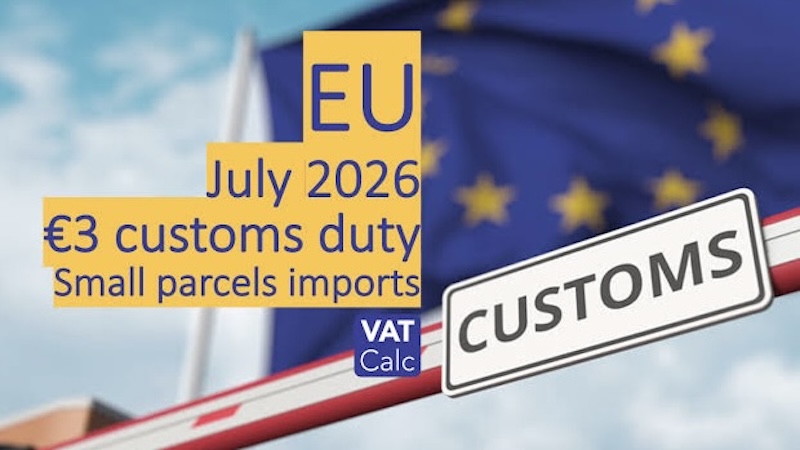
Parcels under €150 used to arrive duty free, and that stopped on July 1, 2026. Small parcels now carry a flat €3 duty for each different type of product inside the box. Five identical shirts trigger one charge. A shirt and a watch trigger two.
Nothing changed above €150, and that is the part most bulk importers miss. The temporary system runs to July 2028, and it only bites if you post parcels one at a time to European customers. Containers were always dutiable and still are, on both sides of the Channel, where UK import duty has run on its own schedule since Brexit.
What to Check Before You Order
Your invoice is the evidence, so it has to say what really happened. The commercial invoice must match the goods, the price, the terms, and the code. Vague wording and suspiciously round numbers invite questions you would rather not answer a year later.
Every shipping term you agree quietly picks who declares, who pays, and who can claim. That is really what CIF against FOB is about, one step earlier in the same conversation.
Before you place the order, pin down five things:
The code and the duty rate: for your product, not the factory’s Chinese export code.
The real freight cost: to Europe, because the tax is worked out on it too.
Where you will clear: and whether you have a VAT number there.
Whose name is the importer: on the customs entry, not on the sales contract.
Who pays the clearance fees: the one charge that really does differ by country and agent.
If one of those is blank, your landed cost is still a guess. Your forwarder fills in the form, but you own what it says, which is why the shipping documents behind it are yours to check.
FAQ
Q1: Is there a China-EU trade deal that lowers the duty?
No. Chinese goods pay the standard rate for their code, and there is no discount to claim. Anyone offering you a lower rate is describing goods from a different country, which is a different problem.
Q2: Can I import into the EU without a company there?
Only with help. A business outside the EU can get a customs number, but it needs a local agent willing to act for it and carry the legal responsibility. Finding an agent who will is the hard part, not the paperwork.
Q3: Could my product carry an extra anti-dumping duty?
Yes, and it is the one that kills margins. The EU adds punitive duties to a long list of Chinese goods, sometimes bigger than the product’s normal rate. Check before you order, not after.
Q4: My goods are made in China but ship from a warehouse in Malaysia. Does that change the duty?
No. Where a product is made decides its origin, not where the box was posted. If that route is being sold to you as a way around an anti-dumping duty, remember which business signs the entry.
Q5: Do I need a VAT number in the country where I clear?
Usually, though the setup varies by country. Before you pick the port, settle who reports the import VAT, who is named on the entry, and how the money gets back to you.
Q6: I sell into both the UK and the EU. Is that one import or two?
Two, since Brexit. Goods cleared into the EU do not arrive in Britain cleared, and shipping to each market straight from China usually beats trucking stock across afterwards.
Q7: Can I delay paying the duty and the VAT?
A bonded warehouse holds the goods with both on pause until you take them out to sell. It suits slow movers and anything you might ship out again, but the storage and admin only pay off at volume.
Q8: I cleared in the Netherlands and now I am selling in Germany. Do I pay VAT again?
Not as an import, because the goods are already inside the EU and moving them is not a second import. Selling in another country brings its own VAT to report, so ask your accountant before you set the price.
Conclusion
The EU has one tariff, so the country you land in is never the reason your duty bill looks wrong. Fix the code, the route and the name on the paperwork before production, and the rest is arithmetic.
Confirming the code from the real product, choosing where you clear, and keeping your own name on the customs paperwork all get decided months before a container reaches Rotterdam. We work through those three with importers as their experienced sourcing partner, so the port becomes a logistics decision again rather than a tax gamble.