
Ship from China to Amazon FBA: Prep It or Pay Twice
Amazon stopped offering prep and labeling as a service you can book on January 1, 2026, which moved that work onto your purchase order. A separate change on March 31 ended the pooling of identical stock, and that one decides which barcode your factory prints rather than who does the prep.
| Prep Job | Who Owns It Now | Cost of Missing It |
|---|---|---|
| Bagging and protection | Factory or prep warehouse | Damage, no reimbursement |
| Unit barcode | Eligibility decides, factory applies | Flagged at receiving |
| Bag warning | Printed or label applied | Rework, unsellable stock |
| Box ID label | You generate, factory prints | Cartons cannot be matched |
Amazon holds you responsible for all four, wherever you decide the work gets done.
What Changed in 2026
The prep and labeling rule reaches every unit that ends up in FBA, whichever route took it there. Your shipment plan no longer offers Amazon as the prep or label owner, so the only answer left is you.
The barcode split is where brand owners save real money. With identical units no longer pooled, brand owners enrolled in Brand Registry as the brand representative can use the manufacturer barcode on eligible listings, while resellers apply Amazon’s own barcode to every unit.
Getting that wrong costs you in both directions. Stickering every unit when you did not have to is money spent on a step the rule made optional. Skipping the sticker when you were not eligible gets the goods logged as defective on arrival.
Factory search, samples, and supplier checks sit in the wider flow of sourcing from China for Amazon, and none of them changed on either date.
Confirming which side of that split you are on, and writing it into the prep instructions, is routine order management work.
Who Owns Prep Now: Factory, Partner, or You
You have three places to put the prep work, and the cheapest is usually the factory that already has the units. Each route changes your cost per unit and where the mistakes get found:
Factory prep: labeled and bagged on the line before packing. Cheapest per unit, and nobody else to blame when a label comes out wrong.
Prep warehouse: a third party fixes labels and rebags before forwarding to Amazon. Costs more and adds days, and on a first order those days buy a check of the factory’s work.
Your own hands: you do the work after the shipment lands. Full control, and the first thing to break as volume grows.
Most sellers start at the warehouse and move upstream to the factory as the spec proves stable. What decides it is whether the written spec has stopped changing, whether a new worker, material, SKU, or barcode file triggers a re-check, and what several runs of inspection records actually show.
Across restocks that becomes supplier management, keeping the same label file and packing spec in force every time the factory reruns the job.
Which Barcode Goes on the Unit, and What Goes on the Carton
Every sellable unit needs exactly one barcode a scanner can read, and your seller status only decides half of which barcode that is. Brand status opens the manufacturer barcode as an option, and each listing still has to be eligible, so check it per product not once per account. Settle it before the factory prints anything, not after the first carton is packed:
Covering: whatever code you apply has to hide any existing barcode on the unit, since two readable codes let a scanner pick the wrong one.
Placement: a flat face, clear of curves, seams, and tape, and in a clear bag a code that reads through the bag needs no second label outside. One code per variation, since mixing sizes and colors turns into miscounts at check-in.
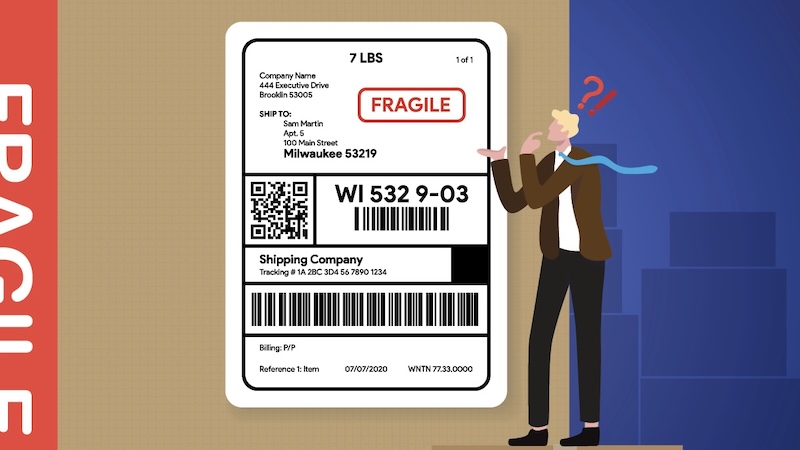
Ordinary box markings do not replace the label Amazon matches on. Every box carries a unique box label generated in your shipment workflow, placed on a flat side away from edges and never across the opening seam. Standard carton shipping marks still do their job for the factory and the forwarder, so both go on the carton.
Labels are the cheapest thing to check and the most expensive thing to redo. A during production inspection partway through the labeling catches a wrong code or a smeared print at a few hundred units, not a few thousand.
Bag and Carton Specs Factories Get Wrong
Poly bag rules are where a compliant product turns into held stock. Bags need to be transparent, sealed, and at least 1.5 mil thick, a mil being one thousandth of an inch. Any bag with an opening of 5 inches or more measured flat needs a suffocation warning.
Printing it on the bag or applying a label both work, which keeps a small run out of a custom printing minimum. The minimum text size scales with the bag’s length plus width, so pin the required size for your bag type in writing rather than leaving the factory to judge what is readable.
Plenty of factories still pack to the old limits. A standard FBA box now runs up to 36 inches long, 25 wide, 25 high, and 50 pounds.
A box holding one oversize unit is the exception. A box over 50 pounds needs a team lift label, and over 100 pounds it takes a mechanical lift label.
A used box is not automatically void, though it has to be a sturdy six-sided box with intact flaps, and every old label, barcode, and marking has to be removed or covered. Confirm dimensions and label specs in Seller Central before the pallet is built.
Who Pays When Prep Comes Back Wrong
Losing the service does not mean nobody touches your units, since Amazon may still fix a fault itself, bill you per unit, and log the shipment as defective, or refuse it outright. Which way it lands depends on the fault, so treating the fix as a safety net is how sellers pay return freight on a full pallet.
The expensive half is the protection you quietly lose. Where a unit is damaged or cannot be tracked because prep or labeling was wrong, that loss falls outside reimbursement, so the stock is gone and nobody pays for it.
Units that arrive scuffed or unsealed draw complaints that read as a design fault, which is why a pattern in your Amazon return reasons often points back to packing.
Write Prep Into the Purchase Order
Prep is a production instruction, not a shipping note, so it belongs in the purchase order next to the product spec. Put bag type and thickness, warning wording and text size, and which barcode applies and where it sits in writing before the deposit. Carton dimensions, unit counts per box, and who attaches the box labels belong there too.
Then check it before the final payment goes out, while the goods are still yours. A pre-shipment inspection verifies unit labels, bag warnings, counts, and packing against your written spec while a rework is still the factory’s to do.
Paperwork rides along with the prep spec. Battery documents, safety data sheets, and test reports are easier to collect before the balance clears. An Amazon compliance check at that point keeps a listing from stalling after stock lands.
FAQ
Q1: Do the 2026 changes apply outside the US?
The prep and commingling changes cover the US store, and other marketplaces run their own prep and barcode rules. Check the destination before you reuse a US packing spec.
Q2: What proof should I ask for when a factory claims FBA experience?
Have them print your own barcode file, apply it to a sample unit, scan it, and photograph a packed carton for this order. Old photographs from other clients prove little either way.
Q3: Who is the importer when a factory quotes a price delivered to Amazon?
Not Amazon, and not automatically your forwarder either. Get the importing company named in writing before you accept a delivered price, since that is who answers for the declaration and the duty.
Q4: Does a manufacturer barcode that sits on several listings still qualify?
No. One manufacturer barcode sitting across several listings disqualifies it, and so does a product that carries no scannable manufacturer barcode of its own.
Q5: Will batteries or liquids hold up intake?
Batteries, aerosols, and some liquids sit in Amazon’s dangerous goods program, and intake pauses until the item is cleared. Clearance attaches to the product rather than each shipment, so recheck it whenever the formula or packaging changes.
Q6: What are my options if I find a labeling fault after the cartons are sealed?
Reopening and relabeling in China is the cheapest route even after the delay. Once the goods have sailed, the fallback is a prep warehouse near the destination, charged by the unit.
Q7: Does an inbound defect stay on my account?
It lands on your inbound performance dashboard rather than your account health rating, so the damage is operational, not a mark on the account. Pull the reason off the shipment record, since it names the exact step that failed, which is what the next purchase order has to fix.
Q8: As I move to my own retail box, does the bag rule still apply?
Sometimes, because the requirement follows the product category rather than the shape of the packaging. Check your category’s prep guidance before you tell the factory to stop bagging, since a sealed box does not remove it by itself.
Conclusion
A fulfillment center does not argue, and that is what turns prep into a production decision rather than a shipping one. The dock either scans your label or it does not, and the decision that settles it was made on the factory floor weeks earlier.
Relabeling at an Amazon warehouse is billed per unit and done by somebody with no reason to hurry. We check the barcodes, the poly bags, and the carton limits in the factory, through order management, so any rework is quoted, scheduled, and re-checked before the balance goes out.