Food Grade vs FDA Approved: What Importers Must Verify
When a factory says its plastic is “food grade” or “FDA approved,” neither phrase is a reason to pay, because neither one names a material, a use, or a document you could hold up if a retailer asked. The FDA does not approve cups, boxes, or bottles; it clears the substances inside them, and some clearances belong to one company for one use only.
| Supplier Says | What It Proves | What to Ask For |
|---|---|---|
| Food grade | Nothing legally binding | Material name and source |
| FDA compliant | A claim, not a basis | Which rule, which use |
| FDA approved | Usually a misused term | What, for whom, which use |
| Same as last order | Only if nothing changed | Materials list, unchanged |
| Tested already | Only at those conditions | Test for your use |
Every row ends the same way: the phrase on the quote gets swapped for paper that names your material, your food, and your temperature.
When the Factory Says FDA Approved
Push hardest on “FDA approved,” because the agency clears substances and uses, not finished lunch boxes, so the claim usually traces back to a brochure from whoever made the resin. Ask three things: what exactly was cleared, for which company, and for which use. The answer usually shrinks to “food grade” within a minute, and that is fine; it is where you stop trading phrases and start collecting paper.
Someone checking the goods on site can pull that paper too, which is part of what product inspection in China covers.
The Three Things a Buyer Actually Has to Know
Every food-contact decision comes down to what the material is, what food and temperature it will meet, and which document covers that combination. Get those three and the vocabulary stops mattering; miss one and no certificate helps. The three questions are the food-contact version of the wider China import compliance check that every product faces.
Material comes first: ask for the resin or alloy grade, its supplier, and any colorant, coating, or additive going into your part. A white bowl and the same bowl in red are two materials here, which is why testing every color and size is worth settling before you approve the second shade.
Use comes second, and it changes the answer. Filling hot, microwaving, freezing, and acidic or fatty foods each change how much moves from the material into the food, so a report for one use may not cover another. Harsher conditions can cover gentler ones: a report run hot and long may serve a cold-water bottle; a room-temperature report will not serve a microwave lunch box.
Document comes third, and here three things line up. The material supplier’s papers say what is in the resin, colorant, or coating and where it came from. For each substance, the supplier points to the FDA rule or clearance that allows it in your use. A finished-product test, at conditions the lab says cover your use, then shows what actually leaks into the food.
The test is not automatic. When every substance is already covered for your use, the lab may confirm in writing that no new test is needed, and that letter, kept on file, does the report’s job. A passed test alone is no green light either; it shows how the article behaved, not that every additive was allowed there.
Metals, Silicone, and Coatings Play by the Same Rules
The material is different but the logic is the same. The grade alone is never enough, and any surface that touches food needs its own answer. A stainless bowl may use an acceptable alloy and still fail on its nonstick interior; ask which grade faces the food and what was done to it.
Silicone seals and gaskets are the parts most often missing from a report, because they come from a second supplier the factory forgot to mention. Prints and coatings on a stacked surface can reach the next item’s food, so tell the lab if the product stacks.
Reading the Paper Before Reading the Result
A test report is worth what its scope, issuer, and conditions say, and a certificate is worth what it names. Four checks cover both. The lab and number check out, as you would verify a test report for any product, and the photo and model are your article. Material and source trace to this order, whoever applied. The conditions match your use, exactly or beyond.
A resin maker’s letter covers pellets, not the bowl molded from them with the factory’s colorant. The supplier compliance documents a factory sends first are usually about the factory, not the product.
Some replies pause payment on the spot. “FDA certified” with no explanation, a report that does not match the SKU, or a refusal to send the whole file all wait until the factory shows the material’s origin and what allows it. A test comes only where the lab says so, and product testing in China covers how to scope one.
When the Deposit Waits
Three replies mean the money stays where it is. “It is food grade” with nothing attached, a report tested at gentler conditions than your use, and a new material supplier hiding under last year’s report all qualify. None of them means the factory is bad; each means the paper is behind the product.
Write that into the order. Tie the balance to evidence that matches your use plus a materials list that has not moved, and put both in the payment terms you agree before production.
If the list does move after approval, the compliance retesting rules decide whether the old report survives. A factory that will not sign has told you which document it lacks, and kitchen products from China walks through the wider category’s other buying mistakes.
FAQ
Q1: Do food-contact articles have to be registered with the FDA before I import them?
No. There is no registration, license, or certificate for a cup or bowl to attach to the customs entry. The shipment can still be reviewed at entry and held or refused if compliance cannot be shown, so the evidence has to exist before the container sails.
Q2: Does “BPA free” mean the product complies?
No. It is a marketing claim about one substance and says nothing about the rest of the material or how it behaves in your use. Treat it like “food grade”: a prompt to ask for evidence.
Q3: Is there a safest food-grade plastic I should just choose?
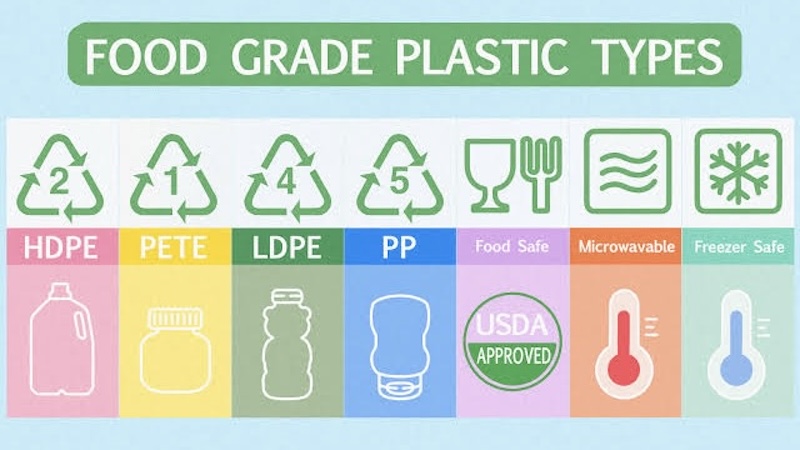
No. Polypropylene, polyethylene, and PET are all common when properly documented, and any of them can fail with the wrong additive or the wrong use. Pick the material for the job, then get the evidence covering it in that use, whether existing or fresh.
Q4: Does a recycled-plastic version need separate proof?
Yes, and a finished-item test alone does not answer it. Ask where the recycled resin came from, how the process removes contamination, and what evidence supports it for your use. An FDA opinion letter on the process is one such route, not the only one, and its absence is not by itself a failure.
Q5: Do tongs or a spatula that touch food only briefly follow the same rules?
Yes. Contact time is one of the conditions in play, so a brief-contact tool is judged for a shorter time, but its substances still need an FDA rule behind their food use. Whether a separate test is required turns on that and on how hot it gets.
Q6: Do “microwave safe” and “dishwasher safe” on the label need their own proof?
Yes, and they are different proofs. Microwave safe means the food-contact evidence covers that heat and the article survives it without warping; dishwasher safe is about surviving repeated washing, a durability question. Decide which words go on the box before the lab quotes.
Q7: How do I check that a 21 CFR section number the supplier sent applies to my product?
That number is one section of the FDA’s food-contact rulebook. Match it on three points: the substance it covers is the one in your part, the use it allows is your use, and any limits it sets are met. A number covering the resin but not the colorant is only part of the answer.
Q8: What if I already ordered and only now realize the report does not cover my use?
Name the gap first. Test conditions too mild for your use: a new test can close it. A substance the FDA has not cleared for your use: no test fixes that, and the material has to change. The contract decides who pays, so agree that split before the first order.
Conclusion
A food-contact product whose material, the FDA rule allowing it, and the evidence covering your use do not line up with the goods is one you cannot defend the day someone downstream asks for proof. By then it is on the shelf, and getting those three to match before you pay is the whole job, with a test added only when one is actually required.
Checking that the resin, colorant, and seals going into the order are the ones the papers describe has to happen at the factory. We do that through product inspection in China, so a changed material shows up in a report rather than in a customer complaint.