Certificate of Origin from China: When You Need One
Most shipments from China clear customs without a certificate of origin, and you only need one when destination customs asks for it, a lower duty rate depends on it, or your bank lists it as a payment condition. It states which country the goods legally come from under the rules that apply, not always where they were assembled. It cannot create a discount in the US, EU, or UK.
| Situation | Required | Which Type |
|---|---|---|
| Standard US, EU, UK import | Usually no | None required |
| Australia or New Zealand import | To claim duty cut | Preferential proof, rules differ |
| Anti-dumping product category | Sometimes | General, if customs asks |
| Bank-guaranteed payment | If listed | Whatever the bank names |
| Reselling to a third country | Sometimes | Whatever that market accepts |
Check the destination rule and the payment terms first, then decide which form to ask for.

Three Reasons the Certificate Is Required
The first trigger is destination customs, and it applies to specific goods rather than to every shipment. Some countries want proof of origin on every commercial shipment; others ask only for particular product groups or when an officer doubts what you declared. Anti-dumping duties are the common case: customs must be sure where the goods really come from, and the port they left from does not settle that.
We check what a shipment’s destination and payment terms actually require before the factory prints a single document, as part of supplier verification for new orders.
The second trigger is a duty cut under a trade agreement. When your country has one with China, the reduced rate is only granted if you present the proof that agreement accepts, in the form it accepts. Without it, customs charges the standard rate at entry, and whether you can claim the difference back later depends on the country and its time limits.
The third trigger is your payment method. When you pay through a letter of credit, so the bank releases money only against listed documents, the supplier must present a certificate that matches the bank’s wording exactly. Small mismatches in buyer name, goods description, or date delay payment. Buyers who set supplier payment terms this way should agree the wording with the bank early.
General vs Preferential: Only One Can Cut Your Duty
There are two kinds, and only the preferential kind can unlock a trade agreement rate. A general certificate confirms Chinese origin for ordinary trade purposes and is what banks, buyers, and most customs offices mean by origin proof. It never creates a discount, though the origin it states can still decide whether anti-dumping duties or a quota apply.
A preferential certificate is issued under a named agreement and only helps if your country has that agreement in force and your product meets its origin rule. Goods merely shipped from China, or assembled there from imported parts with little local work, can fail the rule even though the factory is Chinese. This split is the core of China import compliance on the paperwork side.
What It Does for US, EU, UK, and Australian Importers
For US importers, the certificate does not reduce any tariff, and US Customs does not require one for routine entries. Origin still matters, because US tariffs on Chinese imports depend on it, but customs decides origin from your entry documents and the product itself. A certificate is supporting evidence if origin is questioned, not a filing requirement.
EU importers must declare origin when they clear the goods, but EU guidance says customs should not normally demand a Chinese-issued general certificate to back that up. Certificates are required only under specific import schemes and quotas, and EU import duty is charged at the standard rate either way. UK outcomes are similar, but check UK guidance for your product separately.
The two Pacific markets are the exception, with different rules. Australia normally wants the agreement’s certificate; a declaration of origin replaces it only for goods already covered by an advance ruling from Australian customs. Clear the goods without proof and you pay the full rate, then claim a refund within the time limit.
New Zealand is looser and accepts a certificate, an exporter declaration, or other adequate evidence of origin. In both markets, a valid document on a product that fails the origin rule buys nothing.
Who Issues It in China and What It Costs
Two bodies issue the document in China, the China Council for the Promotion of International Trade, known as CCPIT, and China Customs, and neither charges a fee. The application is made from the China side, usually by the exporter, though some agreements let the producer or an agent apply.
Any amount on your quote is therefore the supplier’s handling, document preparation, or courier cost, or an agent’s service charge. Those charges are legitimate but not official, so ask what the number covers and do not let a supplier present them as a government fee.
Timing is the buyer’s real decision. Many forms can still be issued for a while after shipment, but how long, and what paperwork is needed, depends on the issuing body and the form. Do not treat that window as the plan; settle which proof you need before departure and use late issue only as a rescue.
Verification starts with the issuer named on the document. A CCPIT certificate is checked on the CCPIT public page by number and a China Customs certificate on the customs system, so a customs-issued form is not fake just because the CCPIT page cannot find it. If the issuer’s own system cannot find it, treat it like any other supplier compliance documents that fail a check.
Getting the Details Right Before the Goods Ship
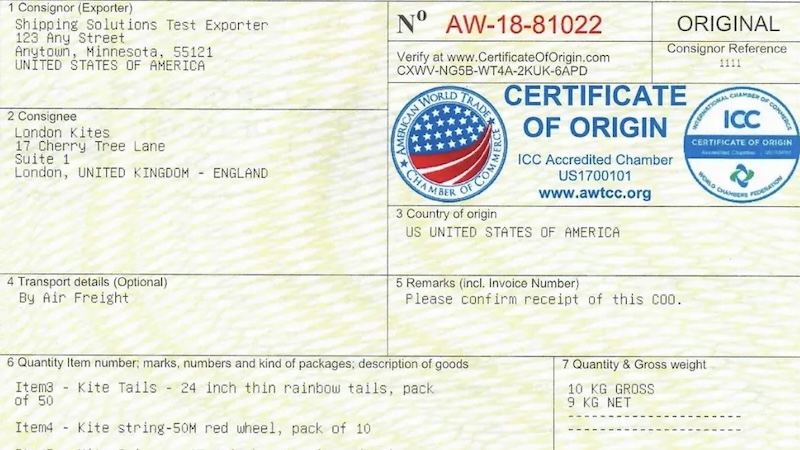
The certificate is only useful if every field agrees with the invoice and the rest of the shipping paperwork, so have the supplier send you a draft before it applies. Customs, banks, and your customers compare it line by line against the invoice and other shipping documents in the set. Correcting a draft costs nothing; correcting an issued certificate means a reissue and often a delay.
Any field can sink it: product description, the HS code from China side, buyer name, invoice number and date, quantities, exporter and producer details, and the box that says why the goods count as Chinese. Read the draft against your purchase order and the final invoice, not the pro forma quote.
If you buy through a trading company rather than the factory, it appears as exporter on a general certificate and customs accepts that. Preferential forms are stricter: many agreements have separate boxes for exporter, producer, and cases where another company issues the invoice. A form that looks complete but puts the trading company in the wrong box can cost you the lower rate.
FAQ
Q1: Should I ask for a certificate on samples or a small trial order?
Only if a customs rule, a duty claim, or your bank actually requires it. On a trial order into America or Europe it usually adds handling cost and a day without changing anything at customs.
Q2: Do I need a certificate for an express courier shipment?
Rarely. Small courier parcels clear under simplified rules and nobody asks. Once the value or product type means a full customs declaration, the same three triggers apply as for sea or air freight.
Q3: What changes when goods made in China are sold to me by a Hong Kong company?
Origin stays Chinese, so the certificate still comes from a mainland issuer through the mainland exporter, not from Hong Kong. Check that the exporter named on it matches the invoice your customs office and bank will see.
Q4: Should I hold the shipment when the supplier needs more time to get the certificate?
Check four things first: can this form be issued after shipment, by what date, does customs need the original at clearance, and when does the bank need its documents. If any answer works against you, waiting is cheaper than paying full duty and hoping for a refund.
Q5: What if the supplier ships the order in two lots on different dates?
Each lot needs its own certificate matching its own invoice and packing list. One covering both usually fails the document check at customs or at the bank.
Q6: What if the factory address on the certificate is different from the one I audited?
First check whether that box is the exporter or the producer, since forms separate the two. If it is the producer box and shows a plant you never audited, treat it as possible subcontracting until the supplier explains.
Q7: What should I do if customs rejects the certificate after the goods have arrived?
Ask the officer which field failed, then have the supplier request a corrected certificate from the same issuer, quoting the original number. Meanwhile decide with your broker whether to clear at full duty now and claim a refund later or hold the goods, since storage costs mount daily.
Q8: How long should I keep the certificate after clearance?
Keep it with the import file for as long as customs can still reopen that import, several years in most markets. If an auditor asks about origin, the answer comes from your file, not the supplier’s.
Conclusion
Before the goods leave China or the bank pays out, confirm three things in one message to the supplier: which proof this shipment needs, which form and issuer, and that every field will match the final invoice. That message settles the certificate question for the order and costs nothing to send.
Reading a draft certificate against a purchase order, confirming which origin rule a supplier relies on, and catching a wrong name before the bank sees it are hard from another time zone. Our team handles that document review as part of supplier verification so the paperwork clears the first time.