
Air Freight from China: Costs and How to Book
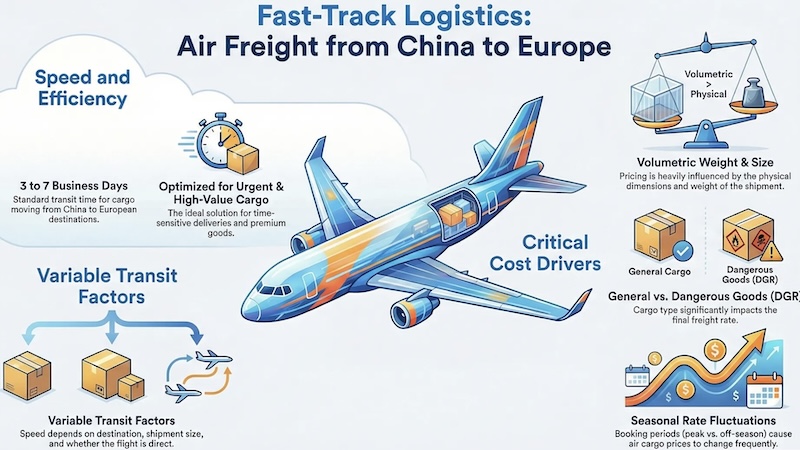
Air freight is billed on whichever is greater, what the cargo weighs or the space it occupies, which is why quotes come back higher than buyers expect. That comparison sets the base freight charge, and handling, surcharges, and delivery are added on top of it.
| Cost Driver | What It Means |
|---|---|
| Chargeable weight | Greater of actual, volumetric |
| Rate break | Price drops at thresholds |
| Surcharges | Fuel, security, screening |
| Handling and delivery | Airport to final address |
Packing changes the volumetric side of the first line, while consolidating or splitting an order is what moves you across a rate break.
Air Freight Is Not Express, and the Difference Is the Handoffs
A courier moves your shipment end to end under one company, while air freight is a chain of separate parties. Trucker, origin terminal, airline, destination terminal, broker, and delivery agent each handle it, and each handoff is a place the schedule can slip.
That chain is why air freight is cheaper per kilo and slower than a courier. For small cartons the courier usually wins on both cost and simplicity, which is worth checking against express shipping options before assuming air freight is the economical choice.
There is no fixed weight where air freight takes over. Route, dimensions, surcharges, minimum charges, and final delivery all move the crossover, so once a shipment outgrows a few parcels, ask for a door-to-door price from both and compare the totals. Where air sits among the other methods is set out in the guide to shipping from China.
Running that comparison while the production date can still be adjusted, rather than the week the goods are ready, is order management work.
How Chargeable Weight Is Calculated
The airline charges on whichever number is larger, the scale reading or the room the cargo fills. That second figure is volumetric weight, and light bulky cargo is billed on it almost every time.
The standard air freight calculation divides volume in cubic centimeters by 6000. A carton measuring 60 by 40 by 40 cm is 96,000 cubic centimeters, which is 16 kg of volumetric weight, so a carton of clothing weighing 9 kg is charged as 16 kg.
| Packed Density, 6000 Divisor | Billed On |
|---|---|
| Over 167 kg per CBM | Actual weight |
| Under 167 kg per CBM | Volumetric weight |
| Near the threshold | Whichever is higher |
Some carriers use a different divisor, so confirm it rather than assume. Express services commonly use 5000, which produces a higher billable figure for the same box, and a quote that looks cheaper per kilo can be more expensive once the divisor is applied.
This is why carton design is a freight decision. Trimming empty space out of the packaging lowers the volumetric figure directly, and the cheapest way to reduce an air freight bill is usually to ship less air.
What the Rate Actually Includes
A rate quoted per kilo is rarely the whole cost, and the gap between two quotes is often just what each one left out. Ask for the same scope from every provider before comparing.
Airport to airport is the narrowest quote, but what sits inside it varies. Some providers fold fuel, security, and terminal handling into the figure while others itemize them, so ask for the scope in writing rather than assuming.
Door to door is broader and still not everything. Ask each provider to list what is included, what is excluded, and what is event-driven, since duties, taxes, remote-area delivery, and examination costs commonly sit outside the quoted figure.
Rate breaks reward slightly heavier shipments. Prices step down at thresholds such as 45, 100, 300, and 500 kg, so a shipment just under a break can cost more in total than one just above it. Ask your freight forwarder to quote both sides of the nearest threshold.
Goods That Need Declaring Before They Fly
Air and ocean follow different dangerous goods rules, and the wrong answer at booking gets the shipment refused at the terminal. Declare anything unusual when you ask for the quote, not when the cargo arrives.
Batteries are the most common problem. Lithium cells face packing, labeling, and state-of-charge requirements that vary with whether they ship alone, inside equipment, or packed alongside it, which is set out in the guide to importing lithium batteries.
Liquids, powders, aerosols, and magnets each have their own handling. None of them is automatically banned, but all of them need declaring, and a magnet strong enough to affect aircraft instruments needs testing before it can fly.
Every shipment has to satisfy security requirements before it can be loaded. The method varies, from X-ray and trace detection to physical search or cargo handled under an approved secure supply chain, so cargo that cannot be X-rayed is not automatically opened or grounded.
Booking and the Airport Handoff
Air freight moves faster than the paperwork does, so the documents decide the flight. A shipment that reaches the terminal without a clean set misses the flight it was booked on.
Book against a cargo-ready date you trust. Space is reserved on a specific flight, and the reason to keep peak season shipping dates in view is that capacity tightens sharply in the same weeks that everyone else is rushing.
Get the commercial invoice, packing list, and air waybill instructions consistent before pickup. Descriptions, values, weights, and consignee details that disagree between them are a common reason air cargo sits on the ground, so check the draft details against each other before the cargo is collected.
Confirm who is clearing the goods at the other end. Air cargo arrives faster than most buyers expect, and storage charges start early, so the broker needs to be appointed before the flight lands rather than after.
When Air Costs Less Than It Looks
The freight premium is only half the comparison, because air removes costs that sit elsewhere in the business. Six weeks of stock sitting on the water is money you cannot use.
It buys back working capital on fast-moving goods. Shorter transit means less inventory funding the same sales, which offsets part of the rate difference on anything that turns quickly.
It protects the orders that pay for the year. A launch date, a retail window, or a stockout on your best seller costs more than the freight difference, and the realistic transit ranges for each method sit in the guide to shipping time from China.
It rarely makes sense on dense, cheap cargo. Anything heavy relative to its value burns the premium without buying anything back, which is the trade-off worked through in sea and air freight.
FAQ
Q1: Can I combine cargo from several suppliers into one air shipment?
Yes, and it usually lands you in a better rate break than shipping each one separately. The cargo has to reach one warehouse first, so build a day or two into the plan for the slowest supplier.
Q2: Who decides which flight my cargo actually takes?
The forwarder books it and the airline confirms it, and cargo can still be offloaded for capacity, weight balance, or a flight change. A booking can also be confirmed or merely waitlisted, and only one of those is worth planning around.
Q3: What happens if my cargo is bumped from a flight?
It waits for the next available uplift, which can be hours on a busy lane or days in peak season. Ask your forwarder to tell you the moment it happens rather than when it eventually flies.
Q4: Can I hold a booking while the factory finishes the last cartons?
Only for a short window, since space is allocated to a flight rather than to you. Give the forwarder the shortfall in writing early, because a part shipment released on time usually beats a full one that misses two flights.
Q5: Can the factory deliver straight to the airport?
Sometimes, and it may save a warehouse handoff when the factory is close to the gateway. Confirm the local sequence first, since cargo acceptance, security screening, and the export declaration happen in a different order depending on the airport and the forwarder.
Q6: Why did my quote change after the cargo was weighed?
Usually because the measured weight or dimensions differ from the ones the quote assumed, though a rate change, a surcharge, or an expired validity period can also do it. Ask which line moved, and treat any quote given before the cartons are measured as provisional.
Q7: Is air cargo insurance worth buying?
Usually, since carrier liability is capped by weight rather than value and air cargo tends to be the higher-value part of your range. The premium is small against the goods you chose to fly for a reason.
Q8: What happens if customs holds my cargo at the destination airport?
Airport storage rates are often higher and the free period shorter than at a seaport, so a document problem gets expensive quickly. Confirm the local rates and free days at booking, and give the broker the full document set while the cargo is still in the air.
Conclusion
Air freight rewards buyers who control the box and confirm the scope, because both are settled before anyone quotes a rate. The cargo that flies cheaply is packed tightly, declared honestly, and booked against a date the factory can actually meet.
Nobody plans to fly a full order, and yet a factory running four days late turns a sea booking into an air invoice several times the size. We hold the production date, the booking, and the documents to one plan through order management, so air stays the choice you made rather than the bill you got.