Made-in-China vs Alibaba: Best for Industrial Buyers?
Made-in-China usually builds an industrial shortlist faster, and Alibaba wins on sheer supplier volume. Its categories are narrower, and neither platform’s badge replaces your own audit, so the sharper question is which one gets you to a verifiable factory sooner.
| What differs | Made-in-China, specialist | Alibaba, generalist |
|---|---|---|
| Supplier base | Industrial-leaning, narrower | Huge, mixed |
| Best for | Machinery, components | Broad discovery |
| Product depth | Deeper industrial specifications | Wider categories |
| Discovery speed | Narrower, targeted | Fast, high volume |
| Supplier filtering | More industrially focused | More suppliers to filter |
| Best when you | Know the category | Are still scoping |
On an industrial order, both platforms get you to a supplier, but only your own checks get you to the right one.
Two Platforms, Two Different Starting Points
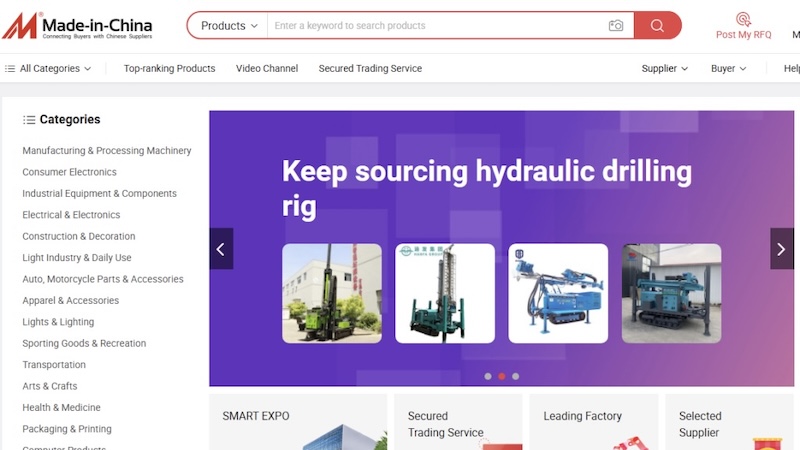
Both sites connect you to Chinese suppliers, but they are built around different buyer habits. The specialist of the two is run by Focus Technology, a company listed on the Shenzhen Stock Exchange, and its directory leans toward factories and industrial categories. Alibaba is the larger, more general marketplace, mixing manufacturers, trading companies, and wholesalers across almost every product type.
For an industrial buyer, that difference decides where you start. Both are export-facing corners of the wider Chinese wholesale websites market, so the real question is how quickly each one puts you in front of a production line.
Supplier Base: Narrow Focus vs Sheer Volume
Made-in-China feels closer to a manufacturing directory than a general bazaar. Its listings skew toward industrial goods, so a search for a gearbox, an enclosure, or a specialized fastener returns a shorter, more relevant set, which is most of what a first pass needs to do.
Alibaba’s advantage is raw breadth, and breadth cuts both ways. You will find more suppliers per search, including plenty of capable factories, but also more trading companies presenting themselves as manufacturers. Sorting the risks on Alibaba from the genuine factories is part of the work, especially in commodity categories with hundreds of near-identical listings.
Whichever directory produced the shortlist, a factory audit is what confirms the plant behind the listing can hold industrial tolerances and run your volume.
Whether you are dealing with the maker is a separate question from which site you used. A trading company with real engineering coordination can serve a technical order well, while custom tolerances often argue for the plant itself, and a profile that calls itself a manufacturer is not evidence of one.
Verification: How Deep Does Each Badge Go?
Alibaba uses layered trust signals rather than a single verdict. Buyers see Gold Supplier status, verified company profiles, transaction history, and third-party assessment reports, which together make a decent first filter. What they do not do is prove that a specific product will meet your standard, so treat an Alibaba verified supplier label as a screen, not a guarantee.
Made-in-China leans on its Audited Supplier program as a headline filter. Those reports come from independent inspection firms like SGS, Bureau Veritas, TÜV Rheinland, and CTI, which verify that the company is genuine and publish what they found on site. That confirms the supplier exists as described, not that it manufactures your product, so read the report rather than the label.
Even so, no badge on either platform ends your due diligence. Certificates expire, get borrowed from another entity, or cover a product that is not yours. The reliable move is a supplier quality audit matched to your exact category, plus independent product testing before you commit to tooling or a full run.
Custom and Engineering Work: Where Industrial Orders Live
Industrial orders rarely turn on price alone, but on whether the supplier can hit your drawings. Tolerances, materials, surface finish, and knowing which drawing version is current all decide whether a part works, and that conversation happens between you and the factory rather than on the platform.
A factory-leaning directory can help here, though it guarantees nothing. A supplier used to industrial work is more likely to read a technical drawing correctly and flag a problem early. Ask for past projects in your category, sample parts against your tolerances, and a clear plan for handling revisions before you scale.
Regulated and safety-critical goods raise the bar further. Verify any certificate directly with the issuing body, lab, or certificate database, because a listing cannot prove it is genuine or that it covers your exact product. A pre-shipment inspection does a separate job, confirming that the units checked match the approved specification, labeling, and packaging. A passing sample followed by a changed bulk material is a classic and expensive surprise.
Price and What Really Drives It
Both platforms are free to browse and quote, so the real cost sits in the order, not the access. Standardized, high-volume parts tend to show tighter price competition on Alibaba simply because more comparable listings exist. Narrower industrial categories may quote more consistently on the specialist side, where holding the tolerance matters more than the headline price.
Compare quotes by scenario, not by the cheapest visible number. Commodity parts hinge on minimum order quantity, packaging, and freight assumptions. Custom components hinge on tooling, how many drawing changes are included, and defect handling, and heavy machinery hinges on export crating and documentation. Normalizing every quote into the same template is what makes a platform comparison honest.
Which Platform Should Industrial Buyers Use?
If your category is clearly industrial and you want factory-level answers fast, start on Made-in-China. Its narrower, industry-led base fits heavy machinery and custom components well, and you spend less time scrolling past unrelated categories.
If you are scoping widely, chasing the sharpest price, or sourcing across mixed categories, Alibaba’s scale is hard to beat. For domestic-market factory pricing on standard parts, some buyers also run a 1688 purchasing agent alongside their export-platform search. The point is to match the tool to the order.
| Your priority | Better fit |
|---|---|
| Machinery and components | Made-in-China first |
| Industrial-category filtering | Made-in-China first |
| Widest supplier pool | Alibaba first |
| Fast price scanning | Alibaba first |
| Custom engineering fit | Either, then verify |
FAQ
Q1: Can I get a supplier to sign an NDA before I share drawings?
Both platforms leave this to you and the supplier, so ask for it in writing before sending technical files. A short mutual agreement is standard for custom industrial work, though whether a supplier signs depends on the project’s value, the terms, and your negotiating position.
Q2: Will these suppliers do design work, or only build to my drawings?
Some offer real design and development support, while many only manufacture to drawings you provide. Ask for examples of custom work they have already delivered in the same product family to tell the two apart.
Q3: How do I confirm a supplier actually owns the factory?
Check the registered manufacturing address, request a live video walkthrough of the line, and, for anything sizable, commission an on-site audit. Ask for the business license too, and match the company name against the address you were given.
Q4: Can I tell from a listing whether a supplier has exported to my market before?
Both platforms show self-reported export markets, which is a hint rather than proof. A redacted bill of lading or a customer reference supports the claim that they have shipped before, but says nothing about your product, so check the certificates, labeling, and declarations your own import requires separately.
Q5: Which platform is better for low-volume industrial prototypes?
Neither is built specifically for prototyping, so the deciding factor is the individual factory’s appetite for a small first run. You will often get further by filtering for suppliers who welcome trial orders than by choosing a platform.
Q6: Do these platforms arrange export packing for heavy machinery?
Usually not, since that is settled with the supplier or a freight forwarder. Heavy or oversized goods need proper export crating specified up front, or they arrive damaged.
Q7: If a bulk industrial order fails inspection, what leverage do I have?
Your strongest leverage is a documented inspection measured against the written specification you both agreed to. That evidence is exactly why an independent check before shipment is worth arranging on any meaningful order.
Q8: Can I ask a supplier to hold my tooling if I move to another factory?
Write tooling ownership and return terms into the order before the mold is cut, because a plant that funded part of the mold will argue otherwise later. Even with clear terms, expect a delay while it is released, and budget for the qualification run the new plant needs.
Conclusion
Choosing between them changes how much time you spend filtering, not how the goods turn out. The drawings, the tolerances, and the checks on the line are all settled long after the platform has done its job.
Neither directory shows you what the workshop looks like on an ordinary Tuesday. We go and look, and a factory audit is what turns a promising listing into a supplier you can commit real volume to.