
20ft vs 40ft Containers: Capacity, CBM, and Cost
A 40ft container holds roughly twice the volume of a 20ft but carries little more weight, which is the whole decision in one sentence. Dense cargo runs out of payload before it runs out of space, and light cargo does the opposite.
| Size | Internal Volume | Realistic Load |
|---|---|---|
| 20ft standard | About 33 CBM | 25 to 28 CBM |
| 40ft standard | About 67 CBM | 55 to 60 CBM |
| 40ft high cube | About 76 CBM | 62 to 68 CBM |
Those figures vary between containers and carriers, so treat them as planning numbers and confirm the actual box before you commit to a loading plan.
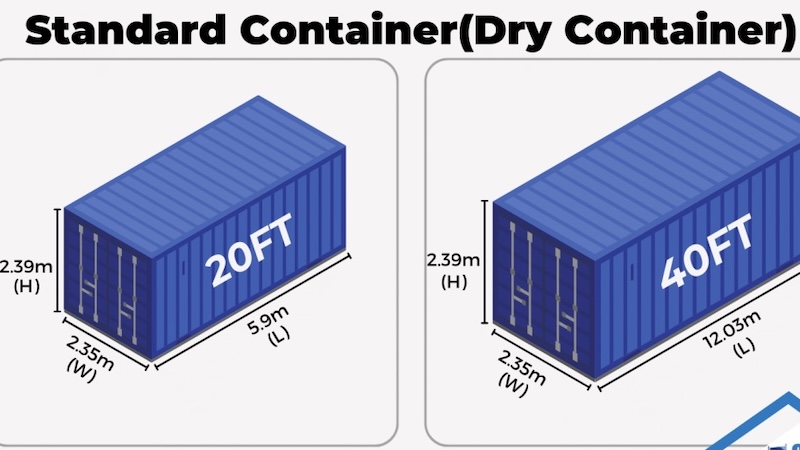
What the Three Standard Sizes Actually Hold
All three are the same width, and only the length and height change. Every standard dry container is about 2.35 m wide inside, so the choice comes down to floor length and, on a high cube, about 30 cm of extra height. It is one of several decisions covered in the guide to shipping from China.
The 20ft is the dense-cargo box. Around 5.9 m of floor length, it suits hardware, tiles, machinery parts, printed matter, and anything where the weight limit arrives first.
The 40ft standard doubles the floor and adds no height. At around 12 m long, it is the default for furniture, packaged consumer goods, and mixed retail loads that fill space rather than the scale.
Getting the carton dimensions and weights out of the factory early enough to run this calculation, instead of after the goods are packed, is purchase management work.
The high cube is the same footprint with more headroom. It takes the same floor space in the yard and on the truck, so the difference is what that extra height lets you stack, with equipment availability and destination height limits deciding the rest.
Why Usable Space Is Less Than the Number
Nobody ever loads a container to its stated volume, and planning against that figure guarantees a surprise. Real loads land 10 to 25 percent below it depending on the cartons, the pallets, and the loading method, and the gap is where most first-time planning goes wrong.
| Where the Space Goes | Typical Loss |
|---|---|
| Gaps between cartons | 3 to 8 percent |
| Pallet footprint and height | 5 to 15 percent |
| Dunnage and door clearance | 2 to 5 percent |
| Uneven carton dimensions | Varies widely |
Palletizing costs you space and buys you handling speed. A pallet raises every carton 15 cm off the floor and rarely matches the container width, so a palletized load fits noticeably less than the same cartons loaded loose. The same arithmetic decides whether you are better off in full or shared container shipping at all.
Carton size decides more than most buyers realize. Cartons that divide evenly into the container width stack with almost no gaps, while an awkward carton leaves a dead strip down the full length of the box. Changing a carton at design stage costs far less than paying freight on empty air.
Weight Fills a Container Before Volume Does
A 20ft container will usually take close to 28 metric tons and a 40ft only slightly more, even though it holds twice the space. Payload is set by the box and the road, not by how much room is left inside it.
Dense goods hit the ceiling early. Tiles, fasteners, liquids, and machinery parts often reach the weight limit with the container half empty, which makes a 20ft the correct choice and a 40ft a waste of money.
Road limits bite before the ship does. Many countries cap the weight a truck may carry on the road well below what the container itself can hold, so a legally loaded box at origin can be undeliverable at destination without repacking. Confirm the destination road limit before you plan the load, and be clear on the difference between gross and net weight when the factory quotes you figures.
How Many Pallets and Cartons Fit
Pallet counts are the fastest way to sanity-check a loading plan. They are also the number most often quoted wrong, because the answer changes completely with the pallet size, which is why the table below names the dimensions rather than calling either one standard.
| Container | 120 x 80 cm | 120 x 100 cm |
|---|---|---|
| 20ft | 11 pallets | 10 pallets |
| 40ft | 25 pallets | 21 pallets |
Those are single-layer figures. Double stacking works only when two loaded pallets clear the door height, the cartons can carry the weight above them, and the load can be secured. Check the height of one finished pallet before assuming the count doubles.
For loose cartons, work from CBM rather than pallets. Multiply the carton dimensions, multiply by the quantity, then compare against the realistic load figure rather than the theoretical one, which is the calculation set out in the guide to calculating CBM.
When the High Cube Pays and When It Does Not
The high cube adds about 9 CBM and may cost slightly more, so the question is whether your cargo can reach the ceiling. Price it on the same lane at the same time as a standard 40ft, because tall stacks of light goods use the extra height while heavy pallets never get near it.
It pays on volume cargo with strong cartons. Textiles, packaging, plastic housewares, and anything that stacks safely to full height will use the extra cube and lower your cost per unit shipped.
It wastes money on anything weight-limited. If the load reaches its weight ceiling at two-thirds of the standard height, the extra 30 cm is empty air you are paying to move.
What the Size Difference Actually Costs
A 40ft rarely costs twice a 20ft, because most of the bill is charged per container rather than per cubic meter. The vessel slot, the terminal handling, the documentation, and the truck to your door are all one-box charges, so the second half of a 40ft is usually the cheapest space you will ever buy.
Quote all three sizes for the same route on the same day. Rates and equipment availability move weekly, so a comparison built from quotes taken two weeks apart tells you nothing.
Compare four lines, not one. Ocean freight, origin charges, destination charges, and inland trucking each behave differently between sizes, and a 40ft that saves on freight can give it back if your address cannot take a long vehicle.
Then divide by what you are actually shipping. Cost per cubic meter shows which box is efficient and cost per unit landed shows which one is right, and the more empty space you pay to move the worse both numbers get.
What to Ask the Factory Before You Choose
You cannot pick a container size from a purchase order, only from packing data. Put the request in writing while production is still running, because once everything is boxed the numbers arrive too late to act on.
Request four numbers per item. Carton dimensions, carton gross weight, units per carton, and total carton count give you both the volume and the tonnage.
Ask whether the cargo will be palletized or floor loaded. The answer changes the usable volume by ten percent or more, and it is a decision worth making rather than inheriting.
Confirm the carton markings and the loading sequence too. Clear carton shipping marks make the container easier to load and far easier to check at the other end.
Where several suppliers are involved, shipment consolidation in China can turn the split into one clean container, and your freight forwarder should quote both.
FAQ
Q1: What if I cannot fill a whole container?
Ship it as a shared container load and pay for the space you use. Around half a 20ft is the point to quote both options rather than assume, since shared loads carry their own handling and destination charges.
Q2: Is two 20ft containers cheaper than one 40ft?
Almost never on freight, since a 40ft usually costs well under twice a 20ft. Two 20ft units make sense when the cargo is too heavy for one box or the goods are going to two addresses.
Q3: Who decides how the container is actually loaded?
Whoever physically stuffs the container, which is the factory on a single-supplier load and the consolidation warehouse when cargo comes from several. Left alone they load for speed, so put the loading sequence, weight distribution, and photo requirements in writing to whichever party is doing it.
Q4: Can I mix pallets and loose cartons in one container?
Yes, and it is common when part of an order is fragile and part is not. Tell whoever loads the container which goes where, since loose cartons stacked on top of pallets shift in transit if nothing separates them.
Q5: Should I ask the factory for a loading plan before production ends?
Yes, and for ordinary light cargo a simple carton layout drawing is enough. For heavy goods such as tiles, fasteners, or machinery parts, ask for weights on that drawing too, since a load that fits the space can still exceed the limit or sit badly on the axles.
Q6: Can I change the container size after the booking is made?
Usually yes before the cutoff, though space on the size you want may not be available and the rate can change with it. Once the cargo is at the terminal it is far harder, so recheck the final carton count against the booking as soon as production ends.
Q7: What if my cargo is too tall or too wide for a standard container?
Open top and flat rack containers exist for exactly this, taking cargo loaded from above or from the side. Both cost more and need lashing and route checks, so raise the dimensions with your forwarder early rather than at booking.
Q8: How do I know the container I paid for is the one that was loaded?
The container number and type appear on the loading photos and the bill of lading, and a check at the loading site confirms both. It is a small check that catches a rare but expensive mistake.
Conclusion
Container size is a weight and volume calculation, and the buyer who runs it from real carton data pays for cargo rather than air. The number to plan against is the realistic load, not the figure printed on a specification sheet.
Factories rarely volunteer carton dimensions, and by the time you have them the quantity is usually fixed. We pull that data while the order is still being agreed, through purchase management, so you book the box that fits the cargo instead of paying to ship air.