China Supplier Compliance: Documents to Get First
Most compliance folders from Chinese suppliers prove the company exists, and nothing about your right to sell its products. Six document types cover the field: three are the floor for every order, and three depend on who exports and what your market demands. The trick is knowing what every paper does and does not prove.
| Document | What It Proves | What It Never Proves | Five-Minute Screen |
|---|---|---|---|
| Business license | Company legally exists | Product quality | Match names everywhere |
| Bank account details | Where money goes | Who owns goods | Match license name |
| Product evidence, any valid form | Item meets market rules | Other models covered | Settle the form first |
| Customs registration | Can ship directly | Market approval | Ask who exports |
| ISO 9001 certificate | Documented internal processes | Your product passed | Check site and dates |
| Social audit report | Labor conditions reviewed | Product safety | Confirm audited site |
Which one arrives when depends on the type, and a schedule later in this article settles the timing.
Why Impressive Folders Prove So Little
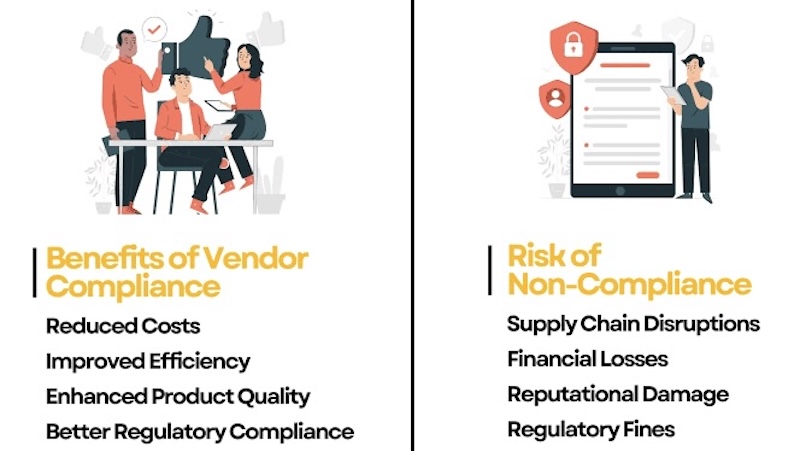
Suppliers send thick document packs because most buyers stop reading after the logos. Sorting the pile into company evidence, which says a real business exists, and product evidence, which says your item meets your market’s rules, is where China import compliance actually starts.
A supplier verification partner on the ground can pull and cross-check these records before your first payment.
The mistake this prevents is specific: buyers approve a supplier on company paperwork, wire the deposit, and only learn at the port that nothing in the folder ever spoke for the product itself. It is also the fairest way to compare Chinese suppliers, since provable files separate lookalike quotes.
The Business License: Read It Like a Bank Would
Three details on the license change your buying decision: the exact company name, the registered address, and the business scope. The name is who you are really dealing with, the address is a lead to compare against the plant you are told about, and the scope shows whether manufacturing is part of what this company is registered to do.
Compare all three against your quotation and draft contract first. A trader registered only for wholesale is fine as long as it says so. A company calling itself the factory while its scope reads like a trader is not automatically lying, but the gap needs an answer, and unanswered gaps open most risks of buying from Alibaba.
Who Actually Exports Your Goods
A perfectly legitimate factory can still be barred from shipping a single carton abroad on its own. Ask whether the supplier exports itself or routes shipments through a trading partner, then request the customs registration of whichever company will appear on the export documents.
The point is accountability, not formality. Whoever is named as exporter is the company customs will talk to, and a China purchase order naming a wrong, unconnected entity gives you a contract with a company that never touched your goods.
One Name on the Money, the Contract, and the Export
Four names appear around every order, and each must connect to the rest on paper: the company quoting, the one signing, the account collecting, and the entity exporting. Identical names are the simple case, but a relationship you can trace on paper protects you just as well. Ask for the agency agreement, group letter, or supply contract that ties the odd name to the rest.
Each kind of mismatch carries its own meaning. A personal account leaves you with no corporate trail at all, while a third-party collector can be routine within a company group, but only when the contract names it and explains why.
An account that changes mid-order is the most dangerous of the three, because a compromised email thread is the standard way this fraud arrives.
Any banking change that arrives by email alone earns a phone call to a number you already had, and the transfer waits until a voice you know confirms it.
System Certificates: Real, Useful, and Not About Your Product
ISO 9001 certifies how a company manages its processes, and no product on earth has ever passed it. Plenty of good factories hold no ISO certificate at all. When one is offered, confirm the named entity and the covered site, because a group certificate often excludes the very building making your order, and a supplier quality audit checks the floor rather than the frame on the wall.
Social audit paperwork works the same way. A labor audit report speaks about working hours and dormitories, not about whether your kettle overheats, and a data-platform membership is not an audit at all. Read the audited site name closely, and treat anything issued to a sister company as decoration.
The Papers That Do Talk About Your Product
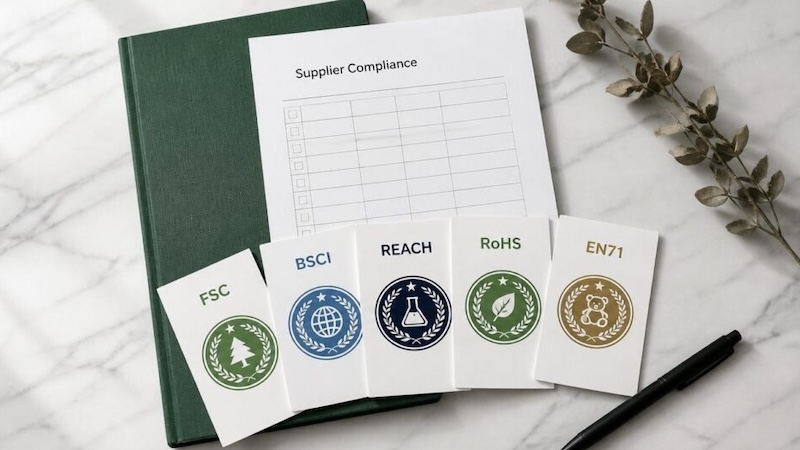
Product-level evidence is the smallest pile in the folder and the only pile that protects your listing. The form varies by product and market: a test report, a signed declaration, a certification record, or a technical file can each be the right proof. Some everyday goods need none of them, and that answer is itself worth having in writing.
Collecting the file is step one, and reading it is a discipline of its own. How to verify a test report against the issuing lab and the exact model is covered in its own guide.
The Latest You Can Collect Each File
Every document has a deadline, and the deadline is always a payment or a commitment. Collect against the four milestones below and the folder builds itself.
| Milestone | Must Have by Now | If Missing |
|---|---|---|
| Supplier screening | Business license, payee match | Pause the shortlist |
| Sample approval | Product evidence, or a written evidence plan | Hold the deposit |
| Before the deposit | Exporter and audit papers, as applicable | Hold until received |
| Before the balance | Independent inspection result | Delay final payment |
Deadlines beat checklists, because a missing file at a milestone forces a decision instead of another reminder. Sample fees sit outside this schedule: they buy a sample, not a pass on the checks that follow.
The evidence plan in row two only counts when it says who tests, by when, who pays, and what happens if the product fails. A smaller deposit never fixes goods you cannot legally sell.
The last row is deliberately not a supplier document, because a factory confirming its own consistency is the checked party vouching for itself. An independent inspection releases the balance for what an inspector can see: looks, count, function, and visible parts.
Things no inspector can see, such as what a plastic is made of or where a battery came from, need their own release condition: a supplier’s material statement or a lab result.
When the File Refuses to Arrive
Three responses tell you to hold your money, whatever else looks good:
The supplier offers only a license and system certificates, however politely.
The names on the documents fail to match the company collecting payment.
Requests for verifiable numbers, sites, or issuers are met with delay instead of files.
None of these makes a supplier a fraud, but all of them move the burden of proof back where it belongs. Walking away early costs little, because ways to find Chinese suppliers are plentiful while provable files are not.
FAQ
Q1: Can I check a Chinese business license myself for free?
Yes. China runs a public enterprise credit system where the code printed on the license returns the registered record, and a quick lookup catches most name and scope mismatches.
Q2: Should I ask for documents in Chinese or English?
Ask for the original, which is usually Chinese, plus any English version the supplier already has. Registration numbers match across both, but the English company name is often a translation or trade name, so the Chinese legal name is the one to match against contracts, bank details, and public records.
Q3: What if the supplier says its documents are confidential?
Registration records and certificate numbers exist to be shown, so blanket confidentiality is a stall. Offer a mutual confidentiality agreement once, and read a second refusal as your answer.
Q4: What does the red company chop on documents mean?
The round red seal is how Chinese companies commonly execute documents, and courts take it seriously. Do not rely on the seal alone: confirm that the person signing has authority to bind the company, and keep the emails showing who negotiated and approved the deal.
Q5: Is it a problem when the license shows a different city than the factory claims?
Often just a headquarters address, but sometimes a workshop that does not exist. Ask which site will make your goods, and expect a plant address you can visit or have visited on your behalf.
Q6: What if the supplier is registered in Hong Kong?
Common and workable, since many mainland factories invoice through a Hong Kong entity. Collect both records plus the paper tying them together, because two registrations alone prove two companies exist, not that one makes what the other sells.
Q7: Can I proceed while a certificate renewal is in progress?
Ask for the renewal receipt or the new audit booking, and decide by document type. Fixed-term certificates differ from test reports that carry no expiry, so weigh what changed, the product, the standard, or the platform’s rules, before a date alone stops the order.
Q8: How often should I refresh documents from a repeat supplier?
Once a year for company records, and immediately after any change in entity name, factory address, or bank account. Renewal dates on certificates set their own calendar.
Conclusion
Make the document schedule part of the deal itself, written into the order alongside price and delivery. Suppliers answer fastest while they are still selling, and the ones with clean files will use them to beat competitors who cannot.
Pulling registration records, matching names across licenses and bank accounts, and confirming which entity really exports takes local access and stubborn follow-up. We handle that legwork inside China, completing supplier verification partner checks before your money crosses any border.