
How to Calculate Landed Cost from China Before Ordering
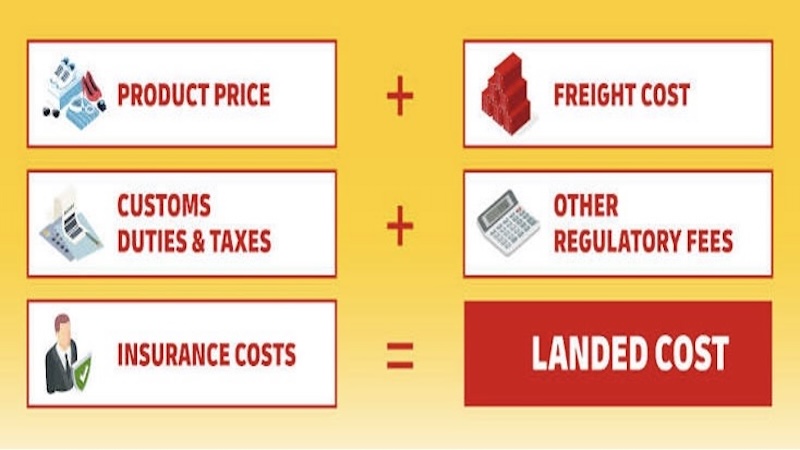
Landed cost is every dollar it takes to get one sellable unit from a Chinese factory into your warehouse, and it is the figure your selling price has to clear. The factory quote is only one line, not the whole decision.
| Cost Block | What It Covers |
|---|---|
| Product | Factory price, packaging, labeling |
| Origin charges | Trucking, export handling, loading |
| Freight | Ocean, air, or express |
| Insurance | Cargo cover, optional |
| Duty and non-recoverable tax | Customs duty, tariffs, unrecoverable tax |
| Clearance | Brokerage, entry, terminal fees |
| Final delivery | Port to your door |
| Other order costs | Payment fees, inspection, sourcing fees |
Check every block against your own order, since some are already inside an FOB or DDP price and others never apply to your product.

The Formula
Landed cost = product + origin charges + freight + insurance + duty and non-recoverable tax + clearance + final delivery + other order costs.
Anything you pay to get that batch sellable belongs in it, including payment fees, inspection, and sourcing fees. Recoverable tax is the exception, since it never becomes a cost the product carries, though depending on how your country handles the return it can still affect your cash.
Divide that total by the units you can actually sell, not the units you ordered. If 1,000 pieces ship and 20 arrive unsellable with no rework and no supplier credit, your per unit cost is the total divided by 980. Units you can rework or move as seconds are a different line, so only write off what you genuinely cannot recover.
Getting three suppliers to quote on the same terms, so the totals are actually comparable, is the part of supplier sourcing that decides whether this model means anything.
Split the model into one-time and repeating costs before you judge it. Tooling, artwork, and first-run testing land once, while freight, duty, and clearance land on every order.
That split tells you whether an expensive first order is a startup cost or a product that stays expensive at volume. It also separates the formula from the wider costs of importing from China that never sit in a per unit figure at all.
Fix the Trade Term Before You Compare Anything
A quote means nothing until you know where the supplier’s responsibility stops. An EXW price means the goods sit finished at the factory and every cost after that is yours. An FOB price means the supplier has already paid the trucking, the export paperwork, and the loading at the port.
Comparing an EXW quote against an FOB quote is the most common way importers pick the more expensive supplier. Put both on the same term first, then add whatever is missing. The choice between CIF vs FOB shipping changes who pays freight and insurance, which changes what belongs in your model.
A Worked Example
Here is the whole calculation on 1,000 units of a small electronics accessory bought at $4.50 FOB.
| Line | Cost |
|---|---|
| Product, 1,000 at $4.50 | $4,500 |
| Sea freight and delivery | $1,200 |
| Duty and entry charges | $650 |
| Cargo insurance | $60 |
| Bank and document fees | $40 |
| Total landed cost | $6,450 |
| Per sellable unit, 980 | $6.58 |
That $4.50 factory price is a $6.58 unit once it reaches your shelf, a 46% increase before you sell anything. If your model needed $6.20, this order needs a renegotiation, a larger volume, or a different freight plan, and knowing that now costs you nothing but a spreadsheet.
The Lines Buyers Forget
Origin charges are the single most forgotten block, because they are billed by someone the buyer never speaks to. Inland trucking to the port, export declaration, and terminal handling in China are real money on an EXW order, and they arrive weeks after you agreed the unit price.
Light, bulky cargo gets billed on space rather than weight, and the quote moves after the forwarder measures it. Work out how to calculate CBM from finished carton sizes, and confirm the gross and net weight on the packing list before you trust any freight figure in the model.
Your product code sets the duty rate, so a guessed code makes every figure under it wrong. The code a factory writes on the export documents is chosen for Chinese export, not for your import, and customs holds you responsible for the one used on entry. Confirm it with a licensed broker before you build a rate into a selling price.
Freight itself is the line most likely to move between your model and your invoice. Rates on China to USA shipping swing with season, port pair, and capacity, so build the model on a current quote rather than last year’s number.
What Moves Your Per Unit Number
Order size is the fastest lever, because tooling, document fees, and minimum charges cost the same on 500 units as on 5,000. Separate those from the charges that scale with declared value or volume. Only the fixed ones get cheaper per unit as the order grows.
A $900 block of fixed charges is $1.80 a unit on 500 pieces and $0.18 on 5,000. That is usually a bigger swing than anything you will win at the factory. The limit is what you can sell inside a normal season, not what the math allows.
Order size is not the only thing spreading that block, because the number of shipments you split into does the same work in reverse. Two suppliers on two bookings pay the clearance, the delivery, and the minimum charges twice on the same total units. Merging them into one consolidated shipment leaves the unit count untouched and halves the fixed block.
Landed cost tells you whether the market price can work, not what your price should be. It stops at your warehouse door. Run the result through the platform fees, advertising, and returns that decide whether you protect your profit margin once the product is actually selling.
FAQ
Q1: Should I calculate landed cost before or after picking a supplier?
Before, using rough figures, so you know whether the product can work at all. Refine it once you have real quotes, because the supplier you pick changes freight, packaging, and often the trade term.
Q2: How accurate can the number be before the goods ship?
Accurate enough to compare options, but not exact. Size your contingency to how many lines are still unconfirmed. A repeat order on a known route needs only a small one, while a first import with unconfirmed carton sizes needs a much larger buffer.
Q3: Which currency should I build the model in?
Build it in the currency you sell in, and convert the supplier price at a rate you write down. If you pay in dollars and sell in pounds or euros, an exchange move between deposit and balance changes your real cost.
Q4: How should I spread tooling, testing, and setup fees?
Decide the number of units you expect to recover them over, rather than loading them all onto the first run. Charging everything to a small first order makes a workable product look dead, while spreading it across a volume you may never reach hides a cost you have already paid.
Q5: Does shipping into a third-party warehouse change the number?
Yes, and usually upward. The delivery leg plus any receiving, prep, or labeling fee belongs in the model, and warehouses that charge per carton quietly reward denser packing.
Q6: What should I do when the freight invoice comes in above my model?
Ask for the itemized bill and find which line moved, because a surcharge, a re-measurement, and a destination fee all get fixed differently. Then update the model rather than treating it as a one-off.
Q7: Does recoverable tax belong in the figure?
Not in the cost, but it belongs in your cash planning. Import VAT you can reclaim later is not a cost, though you may still have to fund it at customs entry. Some countries let you declare and reclaim it in the same return instead.
Q8: How often should I rebuild the model?
At every reorder, and immediately after any freight or duty change. A model built once and reused for a year is the most common reason a product quietly stops making money.
Conclusion
The point of this model is not precision but killing a bad product on a spreadsheet instead of in a container. A figure that is roughly right before the deposit goes out is worth far more than an exact one after the goods have landed, so where a number is genuinely unknown, use a conservative one and mark it.
Three quotes on three different sets of terms is not a comparison. It is a guess with decimal places. We put suppliers on the same basis and pull every charge into the open through supplier sourcing, so the cheapest number in your model is also the cheapest supplier.