
How Long Does Shipping from China Take by Method?
Shipping from China to major US and European destinations takes from 3 days to 8 weeks, and the method you choose only sets the baseline. Booking, consolidation, transfers between vessels, and customs decide the rest, and since quotes measure different parts of that journey, check where each one starts and stops the clock.
| Method | Typical Door to Door | Best For |
|---|---|---|
| Express courier | 3 to 7 days | Samples, urgent top-ups |
| Air freight | 1 to 2 weeks | Mid-size urgent cargo |
| Sea, shared container | 5 to 8 weeks | Small volume, no rush |
| Sea, full container | 4 to 7 weeks | Full loads, planned restocks |
Those ranges assume the main lanes into the US and Europe in normal conditions, and the sections below explain which parts of them you can actually control.
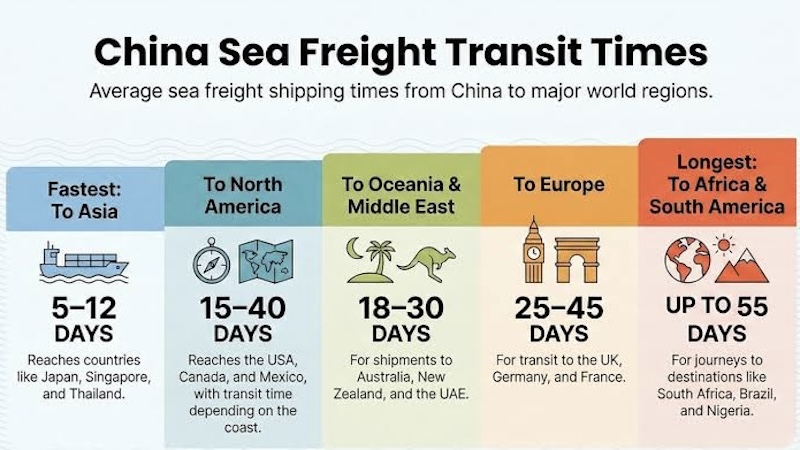
The Clock Starts Before the Cargo Moves
Most buyers start counting on the sailing date, which is why their timelines are wrong by a week or more. The real clock starts when the factory says the goods are ready, and several things have to happen before anything leaves, which is why timing sits alongside method and responsibility in the guide to shipping from China.
Booking and cutoffs come first. Space has to be booked, the cargo has to reach the port before the terminal cutoff, the latest time the terminal will accept it, and the documents have to be submitted before their own earlier deadline. Miss any of those and the goods wait for the next departure, which is where the freight forwarder either earns its fee or costs you a week.
Consolidation adds days at both ends. A shared container has to wait for other shippers to fill it, then be unpacked at destination before your cartons are released, which is why LCL and FCL shipping differ in time as much as in cost.
Building those waiting days into the production schedule, instead of discovering them once production is finished, is purchase management work.
Express, Air, and Sea Compared
The three methods differ in speed and in how reliable that speed is, and the second gap is the one buyers forget. A courier shipment quoted at 4 days usually arrives in 4 days. A sea shipment quoted at 30 can arrive in 26 or 40.
Express courier is a single company doing everything. One operator collects, flies, clears, and delivers, which removes most of the handoffs where time gets lost. Full express shipping options are worth comparing when the cargo is small enough to qualify.
Air freight is faster than sea and slower than it sounds. The flight itself is hours, but the cargo waits for space, sits through terminal handling at both ends, and needs trucking before and after, and that is where the rest of the week goes.
Sea freight is slow in a way you can plan around. Sailings run on fixed weekly schedules, so a missed cutoff costs a whole week rather than a day, and the transit itself varies with the route more than with the carrier. What that difference in days is worth against the extra cost is the trade-off in sea and air freight.
Where the Extra Days Come From
Almost every delay that matters happens while the cargo is stationary. Understanding which pauses are normal and which are avoidable is what turns a transit estimate into a delivery date.
| Stage | Days It Can Add |
|---|---|
| Waiting for booking space | 2 to 7 |
| Transfer to another vessel | 3 to 10 |
| Customs review or exam | 1 to 7 |
| Port congestion | Unpredictable |
| Inland leg to your door | 2 to 5 |
Transshipment is the biggest hidden variable on ocean routes. A direct sailing goes port to port; a transshipped one is unloaded at a hub, waits for the next vessel, and reloads, so two quotes for the same lane can differ by a week for this reason alone.
Customs is three different processes, and they differ enormously in how long they take. Routine clearance happens to every shipment and usually passes without you noticing.
A document review, which can be triggered by an unclear description or a mismatched invoice, adds days while the paperwork is corrected. A physical examination is the rare one, and it can hold cargo for a week or longer while the container is moved, opened, and repacked.
Peak seasons compress everything at once. Space tightens, rates rise, and cutoffs get stricter in the weeks before major holidays, which is why peak season shipping dates belong in the plan before the order is placed.
Destination Changes the Answer
The same cargo leaving the same port can differ by 2 weeks depending on where it lands. Distance matters less than routing and what happens after arrival.
For the United States, the entry point decides the ocean leg. West Coast ports sit closest to the trans-Pacific lanes, so cargo reaches the country sooner. Reaching an eastern destination costs more days either way, whether the vessel sails on to an East Coast port or the cargo lands west and crosses the country by rail.
That head start can also be given back at the terminal, since congestion and the inland leg vary by port. Choosing between the main shipping ports is often worth more time than choosing between carriers.
For Europe and the UK, the routing matters more than the map. Direct services to major ports move predictably, while cargo routed through a hub port waits for a second vessel before it continues.
For everywhere else, check sailing frequency before transit time. A route with 1 sailing a week can cost you more days than a slower route with 3, because a missed cutoff is a full week rather than 2 days.

Building a Timeline You Can Promise
Work backward from the date you need the goods, not forward from the date the factory finishes. The forward version always produces a date you cannot defend to a customer.
Add the four blocks separately. Production to cargo ready, cargo ready to departure, transit, and arrival to your door each carry their own range.
Then add buffer where the variance actually is. A week of buffer on a sea shipment is realistic; a week on a courier shipment is wasted. Put the padding on the stages that slip: waiting for a container to fill, changing vessels at a hub, and clearing customs.
FAQ
Q1: Does cargo ready mean the goods can ship that day?
No. Cargo ready means production is finished, and booking, trucking to the port, and document cutoffs still sit between that date and departure, usually adding several days on ocean freight.
Q2: How far ahead of the cargo ready date should I book?
2 to 3 weeks on ocean freight and about a week on air in normal periods, earlier in peak season or on tight lanes, since space on the sailing or flight you want runs out before anything else does. Check what your forwarder charges for cancelling or changing a booking, because that varies by carrier and is what makes booking early cheap or expensive.
Q3: Why do two forwarders quote different transit times for the same route?
Usually because they are measuring different journeys: one counts port to port, the other counts from factory pickup to your door. Ask both to state where their clock starts and stops before you compare the numbers.
Q4: Who is responsible when the ship arrives late?
Ocean bills of lading and forwarder terms often exclude or sharply limit liability for delay, so a late vessel is rarely something you can recover against. Read what your own contract says about it before the goods move, and treat buffer in your plan as the real protection.
Q5: Is it faster to use a nearer port and truck the goods inland?
Sometimes, and it depends on how much the inland leg costs in days. A port 2 days closer by sea that adds 4 days of trucking is slower overall, so compare the whole route rather than the sailing time.
Q6: Which tracking milestones actually matter on an ocean shipment?
Booking dates are estimates that move, so the events worth watching are the vessel actually sailing, the vessel actually arriving, and customs release. Ask your forwarder to flag those three, plus the date the cargo is available to collect, rather than watching the map.
Q7: Can I speed up a shipment that has already left the factory?
Rarely once it is on a vessel, though before departure you can sometimes buy onto an earlier sailing or switch part of the order to air. The decision point is the cutoff, not the sailing date.
Q8: When is paying for a premium or guaranteed service worth it?
When the cost of being late is larger than the freight premium, which is usually a launch date, a retail window, or a stockout on a fast seller. For routine restocking it rarely is.
Conclusion
A delivery date is a calculation, not a quote, and the buyer who does the arithmetic beats the buyer who asks for a number. Four ranges added separately, with buffer sitting where the variance really is, gives you a date you can hold a customer to.
A factory that finishes three days late misses a cutoff, waits a week for the next sailing, and turns three days into ten. We keep the production date and the booking moving together through purchase management, so a small delay stays a small delay.