
During Production Inspection: Catch a Bad Batch Early
A during production inspection catches a repeating defect while the factory can still fix it cheaply. By the time the goods reach the port the same defect is yours, and every option left costs money.
| Where You Catch It | What It Costs You |
|---|---|
| During production | A fix, if parts allow |
| Before shipment | Rework, delayed sailing |
| At your warehouse | Rework, duty, storage |
| At the customer | Returns, bad reviews, replacements |
Most buyers meet the defect somewhere in the bottom half of that table, after the invoice is paid.
During Production Inspection Explained
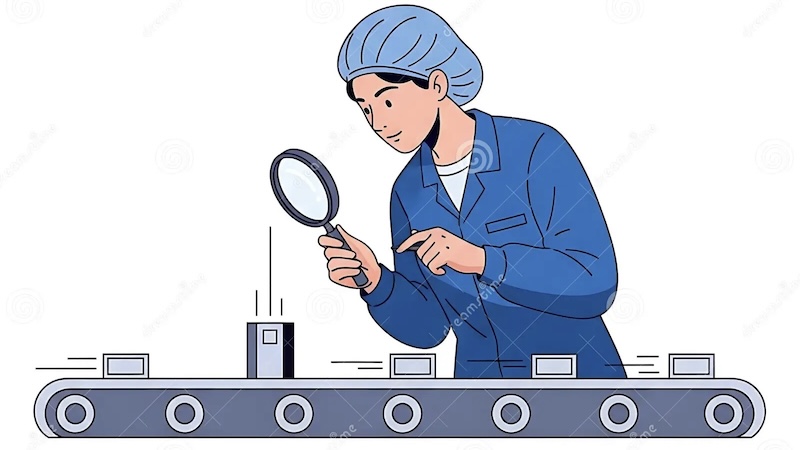
DUPRO, short for during-production inspection, is an independent visit to the factory while your order is still being built. The inspector pulls finished units off the line, checks them against your approved sample and specifications, and reports what has slipped early enough to stop it spreading.
Aim for 20% to 40% complete, when enough units are finished to sample and most of the run is still unbuilt. Past halfway the visit becomes a last chance, and it has to land before the step that cannot be undone finishes or the goods go into bulk packing.
Not every order earns one. How much checking a batch deserves comes down to what can go wrong in it, and that judgment is the core quality control in China decision.
Knowing when the line has actually reached that point takes someone tracking real output rather than the factory’s schedule, which is what manufacturing control is for.
The Water Bottle Case: Same Defect, Two Outcomes
One repeating defect can ruin an order or cost almost nothing, and nothing moves that number like the moment somebody looks. An importer orders 3,000 water bottles and inspects only before shipment, by which point every lid carries the same undersized seal and the choices are rework 3,000 units, discount the lot, or reject it.
Run the same order with a visit at 20% complete and 600 units are affected, while the supplier corrects the specification and the remaining 2,400 are built right. What the early find costs still depends on the fault, on whether replacement seals are on the shelf or need re-tooling, and on how willingly the factory works: days in the good case, weeks in the bad one.
What the Inspector Looks At
A good visit tests whether the order is on track to be right, not just whether today’s units pass. The inspector works to a written standard, which is why an approved sample and an inspection checklist do more for the result than the inspector’s own judgment.
The first layer is what goes in: the approved materials and components are the ones actually in use, and the line is running the version you signed off. The second is what comes out, where finished units are held against the approved sample, function and dimensions are measured, and packaging, barcodes, and carton marks are checked while a reprint still costs nothing.
What to Do With the Report
A report changes nothing until it becomes an instruction the factory has to answer. Count what is already built, bound the problem to a shift, a line, and a range of cartons, then quarantine those units so nobody packs them into the shipment while the question is open.
Let the severity pick the option. A safety or compliance fault stops the line and holds payment until the correction is verified by someone who did not do the rework.
A function fault turns on how bad it is, how far it spread, and whether screening is realistic, so rework, sorting, or a written exception you approve for this batch are all on the table. A cosmetic fault can be reworked, held, or taken at a discount.
Settle the money and the dates in the same message. Name who pays for the rework and the second visit, agree what the ship date becomes, and tie the balance payment to the re-check result rather than to the original schedule.
Get the fix in writing before the line restarts, naming what changed and who verified it, then confirm it on corrected units at the next visit.
When the Visit Pays for Itself
Three groups make the visit easy to justify. A new supplier is the first, because a 50-unit sample says nothing about how a factory performs at 2,000.
A complex or changed product is the second, since more parts, a new material, or a new subcontractor give a single error more places to repeat itself. Long runs and large orders are the third, where a visit in week 2 still leaves room to act and a small defect rate across 10,000 units is still hundreds of bad pieces.
The practical question is which of the inspection companies in China can put someone on site inside that window.
Where It Sits Between the Other Two Checks
Buyers see three stages on an inspection quote, and each buys a different kind of room to act. Which one you book follows the product and the batch rather than habit.
| Check stage | When It Happens | What You Can Still Change |
|---|---|---|
| Initial production check | Start of production | Materials and line setup |
| During production inspection | Order partly built | Most of the batch |
| Pre-shipment inspection | Production done, mostly packed | Little, rework is costly |
The three are not substitutes: an initial production check happens before the run has momentum, and a pre-shipment inspection happens after it has stopped. Production monitoring is a different service again, running from repeated visits at named milestones to someone stationed in the factory full time, with the cost following how much attendance you buy.
What It Cannot Do
The visit checks a sample, not every unit. Sample size may follow AQL sampling, which fixes how many units get opened and, for each defect class, how many finds tip the whole batch from accept to reject, with safety faults usually set at zero.
Sampling may instead be aimed at the risky steps and the units finished so far, in which case the result describes the part already built rather than the batch you will ship.
It does not certify compliance, since an inspector can confirm the materials, markings, and workmanship you approved, but a formal safety judgment needs laboratory testing.
And it cannot fix a factory that will not cooperate, which is what a supplier quality audit tests before you commit the next order.
FAQ
Q1: Does the factory have to let my inspector in?
Only if the purchase order says so. Write access at named stages into the order before the deposit leaves, because a supplier who can refuse entry mid-run decides what you get to see.
Q2: Does the visit cover a workshop the factory subcontracts to?
Only if you say so up front. Ask which processes leave the building before you book, since an inspector sent to the main plant will not travel to a plating shop down the road.
Q3: Can I arrange this without flying to China?
Yes, and most buyers do. A local inspection company visits and sends the report and photographs wherever you are.
Q4: Can the inspector check units that are still on the line?
Yes, against the specification for the stage they have reached, not against your finished-goods standard. Work in progress is where dimensions, materials, assembly direction, coatings, and welds can still be seen before later steps cover them, while the accept or reject call comes from finished output.
Q5: Does the inspection slow my production down?
Usually not, since the inspector samples finished units while production continues. Sampling, function tests, and unpacking can pause a station briefly, and a serious find pauses more than that.
Q6: How fast do I need the report back?
Same day or next day. A report three days late describes a batch that has already moved on.
Q7: Can I compare mid-run reports from different suppliers?
Only if they arrive in one format, with the same defect classes and the same sampling. Ask your inspection company for a single template across factories.
Q8: Should I send the report to the factory?
Send the findings, the photographs, and the correction you expect, and keep your own commercial notes out of it. A factory that sees the same evidence has less room to argue about what was found.
Conclusion
The value of going early is not the defect you find but how much of the order is still unmade when you find it. In the worked example the order failed on timing, not on anything the factory could not build correctly.
A factory will tell you it is 40% complete when the number that matters is how many units are already wrong. We time the visit to the build rather than to a percentage, and stay on the fix afterward, through manufacturing control, so the correction reaches the units still unmade.