
Carton Shipping Marks: What Importers Should Specify
A shipping mark is the only thing about your goods that gets read by everyone who touches them, and the factory will print whatever it has on file unless you say otherwise. Wrong marks turn a routine delivery into manual receiving, chargebacks, and cartons nobody can identify without opening.
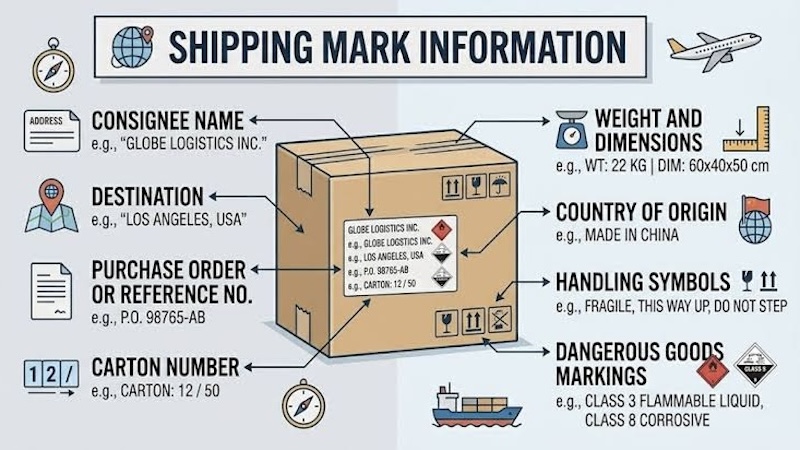
| Field | Example |
|---|---|
| Consignee | ACME |
| PO number | 104882 |
| SKU | WEL-001 |
| Quantity | 24 units |
| Gross weight | 17 kg |
| Dimensions | 46x30x25 cm |
| Country of origin | Made in China |
| Carton count | 3 OF 12 |
Every one of those has a format your receiver expects, and the format matters as much as the information.
What a Shipping Mark Does Not Replace
A shipping mark identifies the outer carton, and it sits alongside several other labels rather than covering for them. Four others commonly share the box: one on the product itself, one applied by whoever transports it, one for dangerous goods, and whatever a fulfillment program requires.
Each of those has its own rules and its own place on the box. Which ones apply depends on how the goods travel, which is one of the first things settled in the guide to shipping from China.
Country of origin is the one buyers get wrong most often. In the United States the imported article itself normally has to be marked, and marking only the outer carton is an exception rather than the default, so check what your product requires before assuming the box is enough.
Checking that the factory printed what the order specified, on the product as well as the box, is what manufacturing control does while the run is still on the line.
None of them can be folded into the mark. Dangerous goods labels follow how the goods are classified for transport, the carrier prints its own, and Amazon or a retailer supplies theirs, so one carton usually ends up wearing several at once.
Send a Template, Not a Description
Telling a factory to print the PO number and carton count produces a different result from every supplier you use. Send a file they can copy from, with the exact wording, order, and punctuation you want to see, since anything left to interpretation gets interpreted into whatever they printed for the last customer.
Reissue it for every order. Factories carry over old PO numbers, previous destinations, and stale carton counts more often than any other marking error, and a template dated to the current order removes the excuse.
The Three Fields That Cause Most of the Trouble
Carton count, PO number, and country of origin generate more receiving problems than everything else combined. All three fail quietly, because the carton looks correctly marked until someone tries to match it to a system.
Carton count fails on format rather than accuracy. A warehouse system reads 3 OF 12 and 3/12 differently, and most retailers and warehouses publish which one they want in their supplier rules. Take the format from that document, not from the factory’s habit.
The PO number has to be yours, not theirs. Factories default to their own internal order number, which means nothing to your receiver, so someone has to work out where the carton belongs by hand and you often get charged for the trouble.
Country of origin has to be written the way your market accepts. Some factories print Made in PRC or leave it off entirely, and for United States imports PRC is not accepted as the English name of the country, so specify China or P.R. China in the template. The wording also has to agree with your shipping documents before either one moves.
Handling Symbols Are Instructions, Not Decoration
Fragile, This Side Up, and Keep Dry work only when they mean something. Marking every carton fragile teaches handlers to ignore the symbol on the one that matters.
Use This Side Up where orientation genuinely affects the product. Liquids, kits, and anything with a fitted tray qualify, and the symbol belongs on more than one face so it still shows when the pallet is turned.
Use Keep Dry for paper, textiles, and anything that may sit outdoors while it waits. Print the symbols large enough to read from several feet away, and keep them off seams, tape, and anywhere the wrapping will distort them.
Regulated Goods Change the Rules
For batteries, aerosols, and similar goods, marking is a legal requirement rather than a preference. The warning labels, battery marks, and which-way-up marks all have to match how the goods were declared for the way they are traveling.
The mode decides the marking, so settle the mode first. What is acceptable by sea may not be permitted by air, which is one more reason the sea and air freight decision belongs before anything is boxed rather than after.
Battery marking depends on how the cells travel. Inside a device, packed alongside one, or shipped alone all carry different requirements, as importing lithium batteries sets out, and your freight forwarder should confirm the exact marks before the factory seals anything.
Amazon and Retail Programs Are Stricter
Selling into a fulfillment network or a large retailer adds label requirements on top of your shipping mark rather than replacing it. The carton still needs your own identification, the label the carrier puts on, and any warning labels, with the program’s labels applied as well.
Amazon labels come from the current shipment plan, never from memory. Each carton needs its own Amazon label from that plan, the carrier’s own label stays on the box, and the contents you declared have to match what was submitted. The Amazon FBA requirements change often enough that last quarter’s file is a liability.
Retail supplier rules work the same way, though the penalty differs. A retailer typically fines you for a marking mistake, while a warehouse like Amazon is more likely to refuse the delivery, receive it slowly, or restrict later shipments. Applying the right format to the wrong customer causes the same problem as applying no format at all.
Check the Marks Before the Cartons Are Sealed
Marks are almost free to fix on the packing table and expensive to fix anywhere else. The check takes minutes and catches the errors that cost days later.
Ask for photographs of a completed carton before loading starts. One image per product or carton group shows the wording, the fields, and where they sit on the box, and it is the fastest check available on any shipment.
Put marking on the inspection list in writing. An inspection checklist that names the carton count format, the PO number, and the origin statement turns a visual glance into a pass or fail.
Set the deadline for marking at the end of production, not at loading. Once cartons are stacked and a container is booked, a correction competes with a cutoff, so marking belongs on the same checklist as everything else that has to be right before the goods move.
FAQ
Q1: Do the marks change if I ship in a shared container rather than a full one?
Your own fields usually stay the same, though whoever combines the cargo may ask for their own reference or booking number on top of them. Being easy to read also matters more, since a shared load is sorted and restacked by people who never saw your booking.
Q2: Should the marks be in English only?
English is standard for export cartons, though some destinations expect the local language alongside it. Check the requirement for the destination rather than assuming, since a second language is cheap to add at print stage.
Q3: Where on the carton should the marks go?
On at least two adjacent faces, so the carton can be read whichever way it sits on a pallet. Put them on the long side rather than the ends when cartons are stacked flush, since the ends are what disappear against the next pallet.
Q4: Printed on the box, sprayed on, or a stuck-on label?
Any of the three works if it survives the journey. Labels are cheapest to change late, printing straight onto the box is cheapest at volume, and sprayed marks suit cartons that will get wet or scuffed.
Q5: What if one shipment goes to two different destinations?
Mark and separate them as two groups from the packing stage, not at the warehouse. Mixed pallets with mixed marks are the most reliable way to send half an order to the wrong address.
Q6: Does anything need to appear on the pallet as well?
Check the receiver’s requirement first, since warehouses, carriers, and platforms differ on whether a pallet label is mandatory. Where nothing is specified, a label repeating the destination and the total carton count still speeds up receiving.
Q7: What should I do if the marks are already wrong and the cargo is packed?
For ordinary buyer fields such as the PO number or destination, relabeling at origin is cheapest, and after departure the choice is relabeling at destination or absorbing the receiving problem. For country of origin or dangerous goods labels, contact your forwarder or broker straight away, since those may have to be corrected under customs or carrier supervision rather than at your convenience.
Q8: What happens to the marks if the cartons are repacked or restacked on the way?
The original marks stay on the cartons, and whoever repacks adds their own labels on top. Tell the warehouse in writing not to cover your marks, since a relabeled pallet with your identification hidden underneath is the same as no identification at all.
Conclusion
Marking is one of the few things in a shipment you control completely, from the wording to the placement, with nobody else’s approval required. The template, the photographs, and one line in the inspection brief cover almost all of it.
A wrong purchase order number on five hundred cartons is not a printing problem but a warehouse that cannot tell your goods from anyone else’s. We read the marks against your template while the line is still running, through manufacturing control, so the correction costs an hour instead of a container.