
Huaqiangbei Market Risks: Why Cheap Deals Cost More
The real risk at Huaqiangbei is not a dishonest seller; it is a market that pays sellers to give you exactly the price you asked for. When buyers compare on price and cannot compare on quality, the only thing left to cut is what you were never going to check.
| The Risk | What It Looks Like | What It Costs |
|---|---|---|
| Price-first buying | Every stall matches the quote | Quality drops next batch |
| No trail behind the stall | Source and grade unnamed | No control, extra margin |
| Fake or refurbished parts | Often passes bench test | May fail in use |
| Orders that do not scale | Work quietly subcontracted | Unknown factory, unknown quality |
| Missing paperwork | Handshake, no documents | Nothing to point at |
Every one of those is cheap to prevent in Shenzhen and expensive to discover at home.

Why a Matched Price Cuts Quality Here
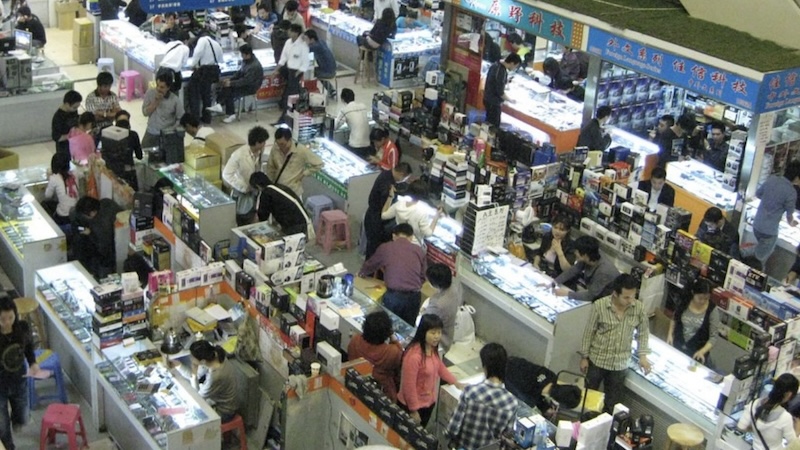
Density is what makes the pressure here different. Hundreds of sellers sit within a few minutes’ walk, so any quote can be checked against a dozen others in an afternoon. That pressure sits higher here than at most other wholesale markets in China, where fewer sellers carry the identical item.
A matched price is the normal outcome, and the material is where it comes from. How to reduce price, not quality is a discipline of its own, and this density is where it matters most.
Counter samples are the weakest evidence you will ever hold. Display units are chosen, handled carefully, and often built under conditions the run never sees. A difference you cannot feel at the stall still reaches your customer.
Getting a unit pulled from the actual run and checked against what you approved is what quality inspection is for, and it is the only evidence that means anything here.
The Pattern in Practice
A buyer sources phone cases from the same stall for two years, then finds the identical style cheaper a few buildings over. He holds both, feels no difference, and asks his usual seller to match. The seller objects once, then matches.
Savings come out of the parts nobody checks. Thinner material and a cheaper pigment are invisible on the counter and obvious after a summer in daylight. The complaints arrive two orders later, when the cause is three shipments back.
The Trail Usually Stops at the Stall
Being a trader is not the problem; losing the trail behind them is. Plenty of trading companies run tight quality control. What hurts is the missing trail: no named plant, no fixed material grade, and nobody accountable when the next run drifts.
Traceability is the thing to test, not the job title. Ask which plant produces the goods, whether the specification can be fixed in writing, and what happens when a batch fails. A seller who answers all three is worth more than one who simply calls itself a factory.
Once you know the plant, verify it properly. A supplier quality audit takes place inside the production facility, never at a booth. Run it before a large order, not after a good sample.
Fake, Refurbished, and Relabeled Parts
Components are the category where a bad batch stays hidden longest. Relabeled chips, pulled parts sold as new, and mixed date codes often pass a quick function check and fail later in use, by which time the goods are with your customers.
The records behind the part are what you are actually buying. Ask for batch codes and datasheets, and check print quality and date markings against the manufacturer’s own. A price far below everyone else is a question, not a win.
On anything high-value, lab screening can expose refurbished, remarked, or suspect parts, though proving a part is genuine ultimately rests on records tracing back to the maker or an authorized channel. Product testing in China answers a separate question about performance, safety, and compliance.
Repeat purchases need repeat checks. Compare every new batch against the unit you approved rather than against the last invoice, since the order that drifts is rarely the first one.
Orders That Do Not Scale
A stall handling a few hundred units well may handle five thousand somewhere you have never seen. Subcontracting is normal and not automatically bad, but an undisclosed workshop reintroduces every risk you thought you had checked.
Ask where the volume will actually be made. How readily that answer comes tells you more than any assurance about capacity. It is also the point to decide whether the order belongs at a stall at all.
Paperwork You Will Wish You Had
Three different things get lumped together as paperwork, and they fail separately. The first is who handles the export, since many stalls are not set up to do it themselves and rely on an agent or trading company to act as exporter.
The other two are the customs set and the compliance file. A commercial invoice and packing list have to describe the goods accurately, while what compliance you need depends entirely on the item and the destination, and no factory supplies it automatically.
A handshake is not a position in a dispute. Specification, quantity, price, and what happens if the batch is wrong all belong in a written order. The discipline behind a China purchase order applies to a market purchase too.
Where the Market Still Wins
Huaqiangbei remains the fastest place to see a category and test a small order. Repair parts, samples, trend-spotting, and first runs all suit it, and the Shenzhen electronics markets are organized so a category can be read in an afternoon.
Scale is where the calculation changes. Volume orders reward a fixed contact, a visible process, and a paper trail, which usually means dealing with the plant rather than the booth. Verification, staged payment, inspection, and consolidation apply either way, and the guide to buying from wholesale markets walks through them.
FAQ
Q1: Which products carry the most risk here?
Anything where a defect stays invisible until the product is in use, so chips, cells, sensors, and certified goods sit at the top. Simple items are lower risk until the volume grows.
Q2: Is a stall cheaper than buying direct from the factory?
Cheaper to start with, since there is no real minimum and no setup cost, though the unit price usually carries a reseller margin. Once volume grows the factory tends to win on both unit price and consistency.
Q3: Does buying from a larger, long-established stall reduce the risk?
It improves the odds of being found again if something goes wrong, which is worth something. It does nothing about material grade or where the goods were made, so the same questions still apply.
Q4: What if the seller will not name the factory?
That alone is not a red flag, since protecting a supply chain is normal commercial behavior. What matters is whether they will fix the specification in writing, allow an inspection, and stand behind a failed batch.
Q5: The samples look identical. What separates the two prices?
Material grade, component brand, and how the run is made, none of which show on a counter sample. Hand both sellers the same written specification and the quotes stop being comparable by accident.
Q6: Can stalls really customize a product?
Most can add a logo or change packaging on something that already exists. Anything touching design, materials, or tooling needs the factory and a different conversation.
Q7: How should I structure payment at a stall?
Keep part of it until you have seen the goods, and use a traceable method rather than cash wherever possible. Paying everything up front to a seller you have not verified removes the only leverage you have.
Q8: What should I keep from a market purchase?
The written order, the approved sample, photographs of what arrived, and any test or inspection report. Those four are the whole of your position if a later batch drifts.
Conclusion
Everything that makes Huaqiangbei fast also pushes it toward the cheapest quote rather than the steadiest supply. Verify who you are dealing with, write the terms down, and check the goods before the balance moves. That is how you get the speed without the tax.
A thinner shell and a weaker dye are invisible at the booth, and by the time your customers find them the balance is long paid. We pull units from the run and test them through quality inspection, so the difference turns up while you still have leverage.