
How to Calculate CBM for Ocean Freight and Reduce It
CBM is the space your cargo occupies, and on less-than-container-load (LCL) shipments it is the number your freight is priced on. Work it out yourself before you ask for a quote, because by the time a forwarder measures it the packing decisions are already made.
| What a quote needs | Why it matters |
|---|---|
| Total CBM | Prices most LCL freight |
| Total gross weight | Compared with volume on LCL |
| Carton dimensions | Taken on the packed carton |
| Carton count | Multiplies into the total |
Give a forwarder only one of these and the rate you get back is an estimate, not a price.
What CBM Actually Prices
Ocean freight sells space, so a heavy compact shipment and a light bulky one can cost completely different amounts at the same weight. On LCL the freight is quoted per cubic meter, or on volume against weight under whichever weight-or-measurement rule your forwarder applies.
A full container load, or FCL, is priced mainly per container, with surcharges and a payload limit on top. There CBM decides which container you need and whether the cargo fits.
If the forwarder measures your cargo first, you have already lost the argument. Volume and weight both belong on the packing list, and the shipping documents are usually where a wrong figure first becomes visible, by which point the cargo is booked. Getting it wrong is one of the quieter costs of importing from China that never shows up as a line item at all.
Fixing the carton size while the product is still being specified, rather than after the first run is boxed, is where product development saves freight without touching the unit price.
The Formula and the Conversions That Trip People Up
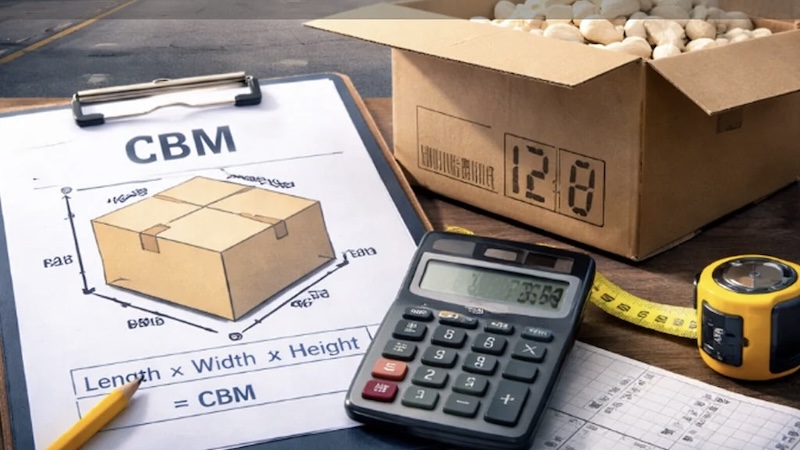
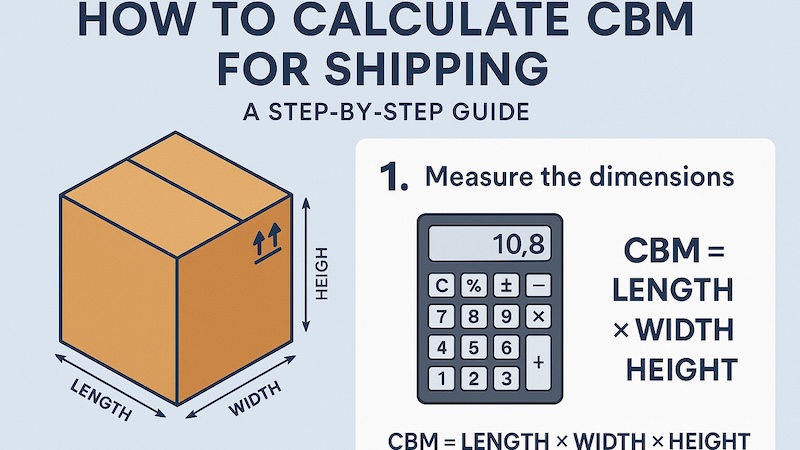
Multiply length by width by height in meters, then scale that by the carton count. From centimeters, either divide each measurement by 100 first, or multiply the centimeter figures together and divide the result by 1,000,000. From inches, multiply each measurement by 0.0254.
Here is the whole calculation on 150 cartons measuring 60 by 40 by 50 cm. Convert to meters and each box is 0.60 by 0.40 by 0.50, which gives 0.12 CBM per carton. Multiply by 150 and the shipment is 18 CBM. That figure is what you hand the forwarder.
Two mistakes account for most of the disputes, and both happen before the arithmetic starts. A supplier who sends dimensions as 600 by 400 by 500 has given you millimeters. Reading them as centimeters puts your answer out by a factor of 1,000.
The second is measuring the product rather than the packed carton. The quote is built on the box with its packaging and padding, not the item inside it. Confirm the dimensions in writing, because 2 or 3 cm per box across several hundred of them moves the total.
Volume or Weight, Whichever Costs More
A quote needs both figures, because the larger of the two is what you are billed on. Many forwarders compare 1 CBM against 1 metric ton, though the ratio moves by carrier and route. The dense shipment is billed on 2.5 tons and the light one on 4 CBM, which is why you send both figures every time.
| Cargo | Volume | Weight | Charged on |
|---|---|---|---|
| Machine parts | 2 CBM | 2,500 kg | Weight |
| Foam products | 4 CBM | 800 kg | Volume |
Treat the weight with the same care as the volume. A quote built on CBM alone cannot hold if the cargo turns out heavier than assumed, and the correction lands on the final invoice.
Gross weight comes straight off a scale with the carton sealed. Net weight is the product alone, so it takes an unboxed sample or the per-unit figure multiplied by the count. The gross and net weight rules cover why freight runs on gross while some duties run on net.
Using CBM to Choose the Container
Once you know your CBM you can see which method is even in play, because containers hold roughly known volumes. Treat those as planning figures rather than promises, since carton size, stacking pattern, pallets, and weight limits all cost you space, and never plan on filling a container completely.
| Container | Usable volume |
|---|---|
| 20ft standard | 25 to 28 CBM |
| 40ft standard | 55 to 58 CBM |
| 40ft high cube | 65 to 68 CBM |
Most importers start comparing LCL against a 20ft box somewhere around 15 CBM. Below that, LCL is normally cheaper, and above it the container often wins once destination charges are counted. That is where the catch sits, because shared shipments carry higher per-cubic-meter handling and delivery fees at the far end, so a low ocean rate can be recovered there.
Ask for a full door-to-door quote broken into line items before you compare anything. Two things then decide the answer at your volume: FCL vs LCL shipping covers which method wins, and the container sizes themselves decide what actually fits.
How to Cut CBM Before Production Starts
Packaging decides CBM as much as shipping does, which means the cheapest time to change it is before the first carton exists. Trim that same carton from 50 cm deep to 45 by taking out empty padding. Across 150 cartons the shipment falls from 18 CBM to 16.2, a 10% cut with no change to the product.
Four levers do most of the work. Shipping goods unassembled cuts volume hardest, and for furniture or anything with a frame it is worth specifying knock-down packaging in the order. Vacuum packing does the same job for apparel, textiles, and foam.
Pushing units per carton from 10 to 12 lowers total volume only where the new box uses its space better. Ask the supplier for the carton efficiency math rather than accepting the first specification offered.
Test any change before you commit to it. Put the new carton through drop and compression testing, and check that a full box is still a weight one person can handle.
Buying from several factories in one region cuts the fees rather than the volume. Combining cargo in China at one warehouse turns two or three small LCL bookings into one. The fixed costs then happen once instead of three times: one booking, one set of documents, one delivery.
The volume itself does not move unless somebody repacks it. Anything billed per cubic meter still applies to the combined cargo, and the warehouse in China may charge receiving per supplier. Converting the result into a freight cost per unit figure tells you whether the change actually paid.
FAQ
Q1: Do I include pallets in the CBM figure?
Yes when the goods ship on pallets, and you measure the loaded pallet rather than the cartons on it. Pallet height and any overhang both count as space you are paying for.
Q2: How do I handle cylinders and odd shapes?
Measure the maximum length, width, and height as though the item sat inside a rectangular box. It occupies that whole space in the container whatever its shape, and that is what you will be billed for.
Q3: Is there a minimum volume for LCL?
There is no formal floor, but most forwarders apply a minimum of 1 to 2 CBM, so anything under 1 CBM carries a punishing rate per cubic meter. Where the cargo is both small and light, express freight can work out cheaper, though a small heavy shipment usually still belongs on the water.
Q4: Does CBM affect air freight too?
Yes, through volumetric weight on a different conversion, where 1 CBM commonly counts as about 167 kg. The higher of actual and volumetric weight still wins, which is why bulky light cargo is expensive by air.
Q5: My CBM is just over a 20ft container. What are my options?
Three: trim the volume through packing, move up to a 40ft container, or send the overflow as a small LCL booking. Packing is normally the cheapest of the three, so price that before you pay for a bigger box.
Q6: What if their measurement comes back higher than mine?
Small gaps are common, since they re-measure at their warehouse. Ask for photos and the measuring method on any difference that changes what you pay. Pallet overhang, repacking, a bulging carton, rounding, and wrong supplier dimensions all look the same from your desk, so check them in that order.
Q7: What happens to my CBM if cartons are repacked before loading?
It changes, and so does the price, so any repacking at a warehouse should come back to you with fresh dimensions. Goods that arrive damaged and get re-boxed may take more space than they did leaving the factory, not less.
Q8: How often do carton dimensions change between orders?
More often than suppliers mention, usually when the box is switched for a heavier one or padding is added. Re-measure on any reorder where the packaging, the product, or the supplier has changed.
Conclusion
The buyers who calculate this early are not better at arithmetic; they simply ask about the boxes while those can still change. Once the cartons are made, CBM becomes much more expensive to change.
Two centimeters off a carton can be the difference between fitting a pallet layer and shipping air around your product for the next three years. We settle the box alongside the item through product development, while it still costs a drawing revision instead of a freight bill.