
Manufacturing in China: Costs, Hubs, and Risks
China wins most products with many parts, custom tooling, or fast design changes, while everything else comes down to your own numbers on volume, duty, and freight. This page is the decision map: what it costs, why the advantage holds, when to look elsewhere, which region to use, and what goes wrong.
| The question | What decides it |
|---|---|
| How much cheaper | Total cost, not the quote |
| Why it stays cheap | Suppliers next door, not wages |
| Whether to look elsewhere | Parts count and duty |
| Which region | The cluster for your category |
| What goes wrong | Your spec and your checks |
Answer these five in order and the sourcing decision mostly makes itself.
How Much It Actually Costs
For many consumer goods, private-label products, and light industrial items, China still lands 20% to 50% below North America or Western Europe. That range holds for labor-intensive, component-heavy, or packaging-heavy products, and it collapses as soon as freight or duty gets large next to the value of the goods.
The quote is not the number. Tooling, packaging, inspection, freight, duty, warehousing, and rework all arrive after the factory price. The gap between a quote and a true landed figure is often wide enough to flip the decision. A realistic view of how much cheaper China is starts there rather than at the unit price.
Putting all seven of those lines beside the quote, before a supplier is chosen rather than after the first shipment, is where product sourcing begins.
Every saving is bought with something. Faster costs more, more stock costs cash, more variety costs complexity, and the supply chain trade-offs behind those choices are where most importers quietly lose margin.
Why the Advantage Survives Rising Wages
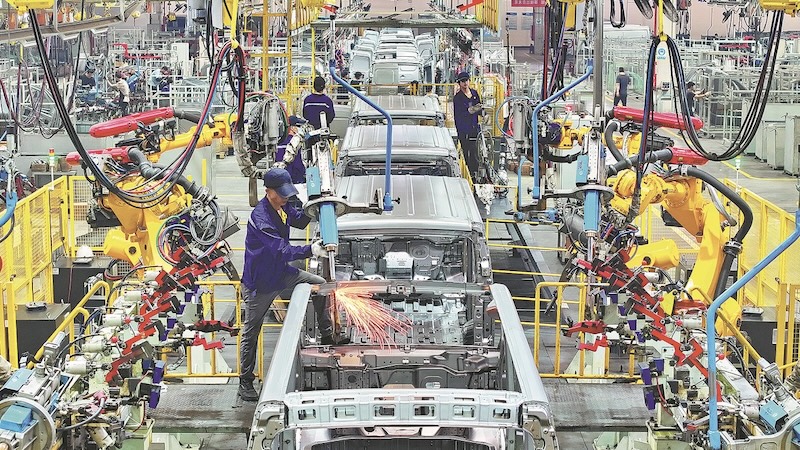
Coastal wages have climbed for two decades and the cost gap held anyway, because the advantage was never mainly the wage. It is density: component makers, tooling shops, packaging vendors, and assembly all inside one region, so a product needing five materials and three processes never leaves it half-built.
That density is what competitors have not rebuilt. Countries with lower labor costs still import components, which adds freight, lead time, and a thinner supplier base. The full case for the China supply chain advantage rests on the parts a buyer never sees on a quote.
The largest buyer in consumer electronics still depends on one supplier for some critical parts. Apple’s own filings disclose it, which is a more realistic model for a small importer than any headline about diversification. The lesson from Apple’s suppliers is how to manage that concentration, not how to escape it.
What China Is Not Good For
The fastest way to waste a quarter is to source a product here that was never going to work here. Four categories fail on arithmetic rather than on capability, and none of them is fixed by finding a better factory.
Bulky, low-value goods. A cheap item that fills a lot of container space loses its advantage to freight before it reaches your door, and no unit price recovers that.
Heavily tariffed categories. When the duty on your product is larger than the manufacturing gap, the saving is gone before the goods sail. Run that calculation before you speak to a single factory.
Volumes too small to pay for a mold. A custom product only earns back its mold above a certain quantity, and ordering below that means paying for a tool you never recover.
Products you can neither stock ahead nor make the customer wait for. If you can hold inventory in the destination market, next-day delivery and Chinese manufacturing coexist without any difficulty, which is how most e-commerce already works. The problem is only the combination: goods that cannot be built in advance, sold to a customer who will not wait out production and transit.
When to Look Somewhere Else
Compare on the same specification or the comparison means nothing. A cheaper quote elsewhere often loses once you count imported parts, longer lead times, and the cost of running two of everything. That is what a real China vs Vietnam sourcing decision comes down to.
Running both is a different question with a real price. A second country means a second tool, more sample rounds, two minimums, and two inspection programs. The China Plus One calculation is whether that premium is smaller than the exposure it covers. For most small importers a second factory in the same cluster answers it more cheaply.
Which Kind of Manufacturing You Actually Need
Most buyers start hunting for a factory before deciding what kind of project they are running, and the three starting points carry very different bills.
Buy an existing product and put your brand on it. Lowest cost, fastest to market, smallest minimums, and the least differentiation, because a competitor can order the same unit off the same line next week.
Change a factory’s existing design. More sample rounds and tighter written specifications, and usually less setup cost than starting from scratch. A change to size, structure, or material can still trigger new tooling, so ask what your change does to the factory’s existing setup before you price the project.
Build to your own drawings. The highest upfront cost and the longest timeline, and the route that gets a product built to your specification rather than someone else’s. Paying for the tooling does not by itself stop a supplier building something similar.
Ownership of the tools and drawings, confidentiality, and any exclusivity have to be written into the contract. That is where product development in China stops being a factory question and becomes a legal one.
Where in China to Make It
China works as a set of regional clusters rather than one manufacturing base, and each cluster owns a category. Source inside your cluster and you get real price competition, samples in days, and a supplier who has built your product before. Source outside it and the factory buys your parts from inside one anyway, with freight and margin on top.
Match the product to the region before you contact a supplier. Electronics sit in Shenzhen, apparel in Guangzhou, furniture in Foshan and Dongguan, small consumer goods in Yiwu, footwear in Fujian, and white goods in Qingdao. The full map of China manufacturing hubs matters more than any single factory’s sales pitch.
Shenzhen is the exception worth naming separately. It puts deep component supply next to fast development, which is why anything with a circuit board or a battery starts there. The range of products made in Shenzhen shows how far that base now reaches beyond phones.
What Goes Wrong, and What Prevents It
The failures are predictable, which is the useful part. Samples that beat production, suppliers picked too fast, costs that surface after shipping, specifications read differently across a border. Then lead times that miss a season, paperwork that stops a container, a copied design, and a single factory with no alternative.
Each one has a moment it has to be caught. A signed reference sample before production, a real capability check before the deposit, a full cost estimate before the order, and an inspection before the balance. Read that list as a checklist rather than a warning, because every item on it has a deadline.
Labeling is where confident buyers still trip. Origin marking is a customs requirement rather than a quality signal, and US customs does not accept the abbreviation on its own. What you print is settled by the Made in PRC label rules, while where the goods legally originate is what sets the duty.
How to Work Through the Decision
Start with one product, not the catalog. A first China project teaches you more about your own specification and your tolerance for risk than about any factory. Pick the item where a mistake is survivable and the volume is real. Everything you learn on it transfers to the next five.
Run the five questions this page opened with, in order, because each answer narrows the next. Answer them out of order and you end up shortlisting factories before you know whether the country is right, then defending that choice instead of testing it. A wrong answer early is cheap to fix on paper and expensive to fix after the deposit.
Write the specification before you shortlist anyone. Until the product is defined you cannot judge whether a factory’s capacity fits, and you cannot get two quotes that mean the same thing.
Send one brief to three factories in the same region. Identical specification, identical quantity, identical delivery terms, because a quote is only comparable when the question was. When one price sits far below the others, ask what that supplier assumed instead of treating it as a win.
Then verify before money moves. A registered company is not a capable factory and a good sample is not a good batch. Ask for the business license, a live video walk of the line, and the name of the person who runs your process. On a first order worth real money, an on-site audit is what separates a convincing profile from a plant that can build your product.
Budget the checks, not just the goods. Samples, tooling, testing, and inspection are line items on the first order rather than optional extras. Buyers who leave them out discover the real cost after committing to a price that never included them.
Decide what happens when something goes wrong before it does. Tie the final payment to a passed inspection rather than to a packing date, and put tooling and design ownership in writing. Agree what a rejected batch means while both sides still want the relationship.
FAQ
Q1: Is manufacturing really leaving China?
Some of it is, and selectively. Simple, labor-heavy products and those facing heavy duty have moved, while complex, tooling-heavy, multi-part products have largely stayed because the supplier base has not been rebuilt elsewhere.
Q2: What size of buyer does China actually suit?
Smaller than most people assume, provided the product fits. Minimums are negotiable in mature categories, and the harder constraint is whether you can fund tooling and hold enough stock, not whether factories will talk to you.
Q3: Do I need a company in China or an import licence to buy from a factory?
Not on the China side, since the factory exports and handles that paperwork itself. What you need sits in your own country: the right to import, a tax number, and a named importer of record, the party legally bringing the goods in.
Q4: Do I need to visit China to source from it?
Not to start, and eventually it helps. A first visit pays for itself on high-value, custom, or tooling-heavy projects, while a third-party audit and inspection cover most standard products without the flight.
Q5: How much cash do I need before I start?
Enough to cover tooling, several sample rounds, the order itself, inspection, and freight, with the goods unsold for the whole lead time. Buyers who fund only the order find out the rest was never optional after they have already committed.
Q6: Should I use a factory or a trading company?
What decides the outcome is engineering support, supply chain control, and who runs quality, not whether the company owns a factory. A capable trading company beats a factory with no project management, so ask who does each job and get the answer in writing.
Q7: How do tariffs change the calculation?
They move it without settling it. Get a broker to confirm your product’s tariff code and where it legally originates before you compare factory prices across countries. A duty difference can be larger than the price gap you are shopping for.
Q8: How do I know I am ready to place the first order?
When you can state the specification in numbers, name the checks that will happen and when, and say what a failed batch would cost you. If any of the three is still vague, that is the thing to fix before the deposit leaves.
Conclusion
China is not a decision you make once but five decisions taken in order. (1) How much cheaper, (2) why it stays cheap, (3) whether to look elsewhere, (4) which region, and (5) what goes wrong. Most of the money is lost by skipping straight to the quote, because the buyers who do well priced the whole route before committing to any of it.
Picking the region, proving the factory is real, and watching the first run are five decisions’ worth of work that all happen where the goods are. We handle that sequence through product sourcing, so you make the calls and somebody is standing there when they get executed.